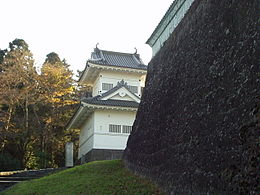
Kubota Castle (Akita)
Kubota Castle reconstruction main enclosure front gate Kubota Castle reconstruction main enclosure front gate
A popular name Yadomi Castle, the kudzu headquarters, Akita Castle
Castle structure A castle on a hill
Castle tower structure Unavailable
The lord of a castle old Yoshinobu Satake
The construction of a castle year 1604(Keicho era nine years)
The main lord of a castle Satake
The abandoned castle year 1880(1880)
Remains of an ancient structure Fieldwork, a moat, the gate, a guard station
Designated cultural assets Akita-shi cultural assets(A leader guard station)
Rebuilding all things in nature This Marushin arms corner oar, a main enclosure front gate
A position 24.53 23.67 lat. 39 degrees N 43 minutes second long. 140 degrees E seven minutes seconds
A summary
It is a castle of Kubota feudal lord Satake. I am called the Yadomi Castle, root of a kudzu Castle. I was able to be called "Akita Castle" concerning land, but the location is together another castle with Akita castle (I got tired come) where Dewa Kokufu was put in the ancient times.
There was a few it, and, in a castle on a hill built in the branch Nibetsu River left bank of the Omono River, the Mt. Akira God in Hodono-mura Kubota (しんめいやま, meters above the sea level 40m), in Ishigaki, it was served fieldwork in the top in a fundus and it could be built and did a palace called a from study with substitute and I built eight oars and was able to line up in the on base without having the castle tower. Ishigaki hesitates not to be it in the Shogunate, and even if I can fold it, it is said when there was not the person who was familiar with the making of Ishigaki, but that the construction of a castle method that originally I do not use Ishigaki for in the eastern country including the former territory Hitachi country of Satake was common is raised. In any case I use Yamakawa Numazawa skillfully and plan defense, and Mizubori and yen Kuo-type castles style of the pilgrimage around the thirty-three holy places in the Kinki district is adopted, too.
The building in the castle was almost destroyed by fire by a big fire of the (1880) in 1880, and most of the moat were filled up by a process of the city rebuilding, too and changed into the government office street. The whole area where there was Kubota Castle becomes Chiaki Park, and Akita citizen of the prefecture hall and Akita municipal institution center library Akinori building, Masakichi Hirano art museum are got ready now. For a building, the leader guard station which escaped from the above-mentioned big fire alone exists, and this Marushin arms corner oar, a main enclosure front gate are rebuilt.
The history / history
Before the Edo era
Miura (Kawajiri) of [4] Ando subordinates was located in the Mt. Akira God and honored a patron saint. The name of the Mt. Akira God comes from this patron saint, too. I was older and was called Mt. Mimori / three Dakeyama because there seemed to be three top.
The Edo era
* It is September 17 (Keicho era seven years) for 1602 years - It is entry into a fortress [5] in Kubota feudal clan Dewaminato Castle that it was Yoshinobu Satake who is the first feudal lord, a castle of Ando.
* It is May (Keicho era eight years) for 1603 years - I construct a castle and start Shinshiro in the Mt. Akira God (a patron saint of Miura, Kawashiri-mura Shimohama, move [6]). I perform the maintenance of the main important doctrine that castle town and Ieyasu Tokugawa promoted at the same time.
* It is August 28 (Keicho era nine years) for 1603 years - The Kubota Shiromoto-maru completion. I do 破却 of Minato Castle and fix Kubota Castle for Honjo. In addition, the main important doctrine abreast of the other feudal clans is completed within this year.
* 1607(Keicho era 12 years) - The town percent (the first) of the inner town starts. Outermost outworks and medium-grade articles enclosure were founded. The town percent of the outside town is considered it to have been started these days.
* 1619(Genna five years) - The town percent (the second) of the inner town starts. Medium-grade articles enclosure cured percent, and left, and tortoise ノ-cho enclosure was founded.
* 1629(Kanei era six years) - The town percent (the third) of the inner town starts. Samurai-cho of Narayama / Hodono / bill / Kawaguchi is founded.
* 1631(Kanei era eight years) - Through the way which links the horse mouth trouble-cho to Kajicho, it establishes this Oomachi line with a highway (Dewa highway).
* Run to (Masayasu two years) from (Kanei era ten years) in 1645 in 1633 - It is Kubota Castle and changing of a name [7] in Kubota Castle.
* 1635(Kanei era 12 years) - Osamu.old
* 1671(Kanbun 11 years) - It is town percent in Atago bottom new mansion.
* 1673(The Enpo era first year) - It is town percent in Tsukiji / Nagano bottom.
* 1699(Genroku era 12 years) - It is town percent in bill Toshincho / bill Nishijin-cho.
* 1781(The Tenmei era first year) - Osamu.old
Modern times
* 1868(1868) - Boshin War. Because the Kubota feudal clan supported new government troop, I took attack from the Shonai feudal clan (Shonai war), and it was approached to Shiroshita 12km, but the Kubota castle avoided the war damage because I received the surrender of Sendai feudal clan / the Yonezawa feudal clan, and Shonai feudal clan withdrew.
* It is June 17 (1869) for 1869 years - Return of the land and people from the feudal lords to the Emperor. The site of a castle becomes the jurisdiction of the ministry of military affairs (the department of army).
* 1871(1871)
o January 13 - I change Kubota feudal clan to Akita feudal clan and rename Kubota castle town to Akitamachi.
o July 14 - Establishment of prefectures in place of feudal domains. The Akita prefectural office is put in the main enclosure.
* It is March 13 (1872) for 1872 years - The Akita prefectural office moves to 土手長町上丁, and Kubota Castle becomes uninhabited.
* It is January 14 (1873) for 1873 years - I become 存城処分 by national castle maintenance or abolition ノ 処分並兵営地等撰定方.
* It is July 19 (1880) for 1880 years - A building in the castle is almost reduced to ashes by a big fire.
* 1890(1890) - The site of castle is disposed of to Satake by the department of army.
It is the reference present age in "the Chiaki Park # history" about the park got ready by the site of castle
* 1989(1989) - I restore this Marushin arms corner oar (a corner oar).
* 2001(2001) - I restore a main enclosure front gate.
* 2004(2004) - 秋田市建都四百年記念祭 holds it.
* It is April 6 (2006) for 2006 years - It is chosen by 100 Japanese fine castles (the ninth).
* It is June (2007) for 2007 years - 100 Japanese fine castle stamp rally of the national scale starts.
Structure
I levelled the most high place of the Mt. Akira God and assumed it a main enclosure, and a main enclosure palace and the government affairs place which were the house of the feudal lord were put here. A front gate (one ノ gate), a rear gate, the obi gay quarters gate, a small back gate, five places of doorways called the side door mouth were established to the surroundings.
I assumed the land where had low one step of the main enclosure East the outworks of a castle, and a government office of the Shogunate in charge of finance, a border government office, the House of prayer place comfort, a time bell, Kinzo, a stable were put.
There were outermost outworks to surround the north / the east / the south of the outworks of a castle, and a chief vassal mansion was put. I call lower Zhongcheng, the northeast a mountain ノ hand (bill Kamimachi) in upper Zhongcheng, the southern part in the eastern part. Hachimanyama in the west (the northwest of the main enclosure) of the mountain ノ hand was included in outermost outworks, too, but small Yahata Corporation / Inari Corporation / 別当寺金乗院 was put not a chief vassal mansion.
I surrounded a main enclosure / the outworks of a castle with Uchibori and surrounded the outermost outworks in an outside moat. Furthermore, there was a north circle in the north side, and a barn and a granary for unhulled rice were put very much. Arms storehouse was put in 捨曲輪 which I was sandwiched in between the western inside and outside moat and became in the shape of an island.
A school and the mansion of the chief vassal were arranged in a circle, and the mansion of the low-class vassal was posted in the domain called "an inner town" of the circumference the inside. The merchant-cho was called "outside town" (I wait), and I was posted in the west of the castle across Asahikawa. A temple was installed in the west intensively in the watches of the night of the outside town.
11/21/2009
11/11/2009
Sendai castle
The Sendai castle (せんだいじょう) is a castle on a hill in blue Hayama of current Aoba-ku, Sendai-shi, Miyagi (Michinoku country Miyagi-gun). The pen name "Aoba-jo Castle." (→ Sendai reference) that there is another name with "Gojoro". It was appointed (2003) on the historic spot of the country on August 27 in 2003.
A summary
I crossed it in about 270 to an establishment of prefectures in place of feudal domains / abandoned castle law after Masamune Date constructed it in the Keicho era year, and it was a castle of Date charges, and it was the administrative office of the Sendai feudal clan. It is appointed on the historic spot of the country.
I could put a function as the fortress away though I repeated restoration without several degrees while earthquakes suffered damage and passed through Boshin War as depths Uetsu powerful feudal lords alliance leader without never watching the war, and I could write it afterwards in the Taisho era from the Meiji early days, and the most were lost. Ote-mon Gate which was few remains of an ancient structure, side oar, 巽門 were appointed to a national treasure (an old national treasure), but it underwent the war by the air raid of the Pacific Wars and was destroyed by fire. Currently, the member of the gate of 寅 converted into the building of the Governor of Miyagi official house front gate is left.
Because I am located in blue Hayama, with a pen name called Aoba-jo Castle (あおばじょう), I generally tend to be called Aoba-jo Castle. This is unidentified whether mountain and which of the castle got the name of "green leaves" with the place name which was created since Sendai castle is done earlier. Blue Hayama comes from one of 仙台七崎 "green leaves ヶ 崎".
The history / history
Before the Edo era
Blue Hayama has a castle from the Date past, and I call myself a castle for 1000 generations, and I can write it at the middle in the Muromachi era from last years in the Kamakura era, and, 1,000 castles, Shimazu will do a castle as Michinoku Mamoru later at the start, and it is told even if Kokubun of local people of Kokubu Zhuang did a castle in last years in the Muromachi era.
The Edo era
When lord of a castle Morishige Kokubun who was an uncle of Masamune Date ran away in rivalry with Masamune, Sendai Castle became the abandoned castle.
I decided Masamune got the permission of Ieyasu Tokugawa after a fight of Sekigahara, and to move a castle to Sendai. I climbed blue Hayama to (Keicho era December 24, 5) on January 28, 1601 and, including the territory, changed the place name to Sendai. The Sendai castle which he built was Yamashiro consisting of a main enclosure and the western citadels of the castle and there was the castle tower, but did not have the castle tower. It was these points, and I turned my back, but it was being prevalent in the times with a matchless impregnable castle at the same period so as, as a result, the Sendai castle did Vizcaino, and to make you say "the only one which I was superior, and was the strongest again of Japan".
However, I started outworks of a castle building, and (Kanei era 14 years) was able to complete Tadamune Date in the next year in 1637 when the world became the peace of mind because the road of Yamagami and the foot was inconvenient. There is it in the inside of Hirose River as well as a main enclosure, but land is a flat place. The present head of a household of the the Dates lived in here, and the administration was done here, too. As for the time, I was missing, but outermost outworks were made with this almost simultaneously in major Kadowaki, the foot of blue Hayama. After this, the Sendai castle became the castle on a hill.
I lost a part of building and Ishigaki sometimes, and, through the Edo era, the Sendai castle was rebuilt by a fire and an earthquake each time. Because Sendai did not need to become the battlefield by the Boshin War either, the Sendai castle was able to put a duty as the fortress away since the foundation without taking attack once.
Modern times
The Tohoku head of the garrison of Imperial Army made Sendai castle the headquarters and was stationed. A main enclosure was destroyed then, and a stone and a tree were diverted to barracks construction. The northeastern stationary troops were renamed to Sendai stationary troops later. Furthermore, the second division was put when stationary troops system turned into a division system.
* A shrine dedicated to the spirits of the war dead was built in the ruins of the main enclosure (1904) in 1904. It is current 宮城縣護國神社.
* A gate built between the main gate and the main house of the palace-styled architecture in the Fujiwara period in the middle to the main enclosure was demolished (1920) in 1920 by Ote-mon Gate, and it was removed and reconstructed by the front gate of existing governor diplomatic establishments.
* Ote-mon Gate and a side oar (a corner oar) are appointed to an old national treasure (1931) in 1931.
* Masamune image was removed (1943) in 1943 by metal kind collection law. It should have dissolved entirely, but it is discovered that the chest was not dissolved by a head after the war. This bust is exhibited now in Sendai Municipal Museum.
* Occupied outworks of a castle list stage dressing rooms were destroyed by fire by an incendiary dropped by B29 of the United States Armed Forces in the case of Sendai air raid by U.S. forces entirely (1945) in Ote-mon Gate, side oar (a corner oar) (a national treasure), a guard tent in before dawn of 10th in July in 1945 of the last years of Pacific Wars, and the defense of the fatherland Shinto shrine was destroyed by fire. The building to be transmitted through by this from the Edo era became only 巽門 (たつみもん) of outermost outworks (there is the opinion destroyed by fire by the war damage of this day).
The present age
* U.S. Army was stationed after the war in the ruins of the second division, and it was lost building remains of an ancient structure for Edo period that existed that Sendai castle sign had entirely by three 丸巽門 having been done 破却 of. The U.S. forces returned here to the (1957) in 1957.
* The Masamune image removed during war (1954) in 1954 is rebuilt by concrete. This was a statue.
Tokoku University was in the outworks of a castle ruins after it was returned and became the Tokoku University Sendai campus. Among Sendai campuses (Sendai north campus, Sendai south campus), four faculty of liberal arts departments of the southern part, an attached library, a place with the attached botanical garden are the outworks of a castle.
* Miyagi Shrine (a name of the occupation period of 宮城縣護國神社) received national land disposal (1950) in 1950 and owned the main enclosure whole area. In Sendai-shi, a castle did not wish it was stolen the Shinto shrine and I negotiated and managed the part of the land and purchased a part. As of 2003 (2003) the part of the main enclosure of a thing of Sendai-shi but a part and a western citadel of the castle of the main enclosure are still things of the defense of the fatherland Shinto shrine. The person visiting the castle will watch a big torii and the signboard which it was written that I "will let you continue Yasukuni shrine official visit" in the place where there was the filling gate that is a central station. The front shrine of the defense of the fatherland Shinto shrine and Aoba-jo Castle museum, a dining room occupy the center of the main enclosure.
* Sendai Municipal Museum was opened (1961) in the outermost outworks ruins in 1961. The moat of outermost outworks stays as Naganuma, Lake five colors.
* A bronze statue was rebuilt (1962) in 1962, and it was erected as a mounting a horse image. Erected it earlier; concrete; stood, and the image was transferred by Iwade Yamashiro of Iwadeyamamachi (existing Osaki City).
* It was appointed (2003) on the historic spot of the country on August 27 in 2003.
* Aoba-jo Castle main enclosure Hall extended business hours than (2005) until 10:00 p.m. in 2005 and has begun to lay emphasis on night sightseeing around the night view of the Sendai-shi inner city to look at from Sendai Shiromoto-maru.
* It was chosen (2006) on April 6 in 2006 by 100 Japanese fine castles (the eighth), and 100 Japanese fine castle stamp rally of the national scale was started in June (2007) in 2007.
* "Moon automatic performance of the wake" to be able to put before Bansui Doi bronze statue with (2008), Sendai / Miyagi destination campaign in 2008 all day long from three times ten times (from 9:00 to 18:00) I increased it in) to 00 for every one hour. In addition, I came to light up Masamune Date mounting a horse image of Sendai Shiromoto-maru and Ishigaki by whole year from sunset to 11:00 p.m. To this, I did a toll parking lot (in the daytime normal car 400 yen / time) in the main enclosure with free opening by night after 6:00 p.m.
A summary
I crossed it in about 270 to an establishment of prefectures in place of feudal domains / abandoned castle law after Masamune Date constructed it in the Keicho era year, and it was a castle of Date charges, and it was the administrative office of the Sendai feudal clan. It is appointed on the historic spot of the country.
I could put a function as the fortress away though I repeated restoration without several degrees while earthquakes suffered damage and passed through Boshin War as depths Uetsu powerful feudal lords alliance leader without never watching the war, and I could write it afterwards in the Taisho era from the Meiji early days, and the most were lost. Ote-mon Gate which was few remains of an ancient structure, side oar, 巽門 were appointed to a national treasure (an old national treasure), but it underwent the war by the air raid of the Pacific Wars and was destroyed by fire. Currently, the member of the gate of 寅 converted into the building of the Governor of Miyagi official house front gate is left.
Because I am located in blue Hayama, with a pen name called Aoba-jo Castle (あおばじょう), I generally tend to be called Aoba-jo Castle. This is unidentified whether mountain and which of the castle got the name of "green leaves" with the place name which was created since Sendai castle is done earlier. Blue Hayama comes from one of 仙台七崎 "green leaves ヶ 崎".
The history / history
Before the Edo era
Blue Hayama has a castle from the Date past, and I call myself a castle for 1000 generations, and I can write it at the middle in the Muromachi era from last years in the Kamakura era, and, 1,000 castles, Shimazu will do a castle as Michinoku Mamoru later at the start, and it is told even if Kokubun of local people of Kokubu Zhuang did a castle in last years in the Muromachi era.
The Edo era
When lord of a castle Morishige Kokubun who was an uncle of Masamune Date ran away in rivalry with Masamune, Sendai Castle became the abandoned castle.
I decided Masamune got the permission of Ieyasu Tokugawa after a fight of Sekigahara, and to move a castle to Sendai. I climbed blue Hayama to (Keicho era December 24, 5) on January 28, 1601 and, including the territory, changed the place name to Sendai. The Sendai castle which he built was Yamashiro consisting of a main enclosure and the western citadels of the castle and there was the castle tower, but did not have the castle tower. It was these points, and I turned my back, but it was being prevalent in the times with a matchless impregnable castle at the same period so as, as a result, the Sendai castle did Vizcaino, and to make you say "the only one which I was superior, and was the strongest again of Japan".
However, I started outworks of a castle building, and (Kanei era 14 years) was able to complete Tadamune Date in the next year in 1637 when the world became the peace of mind because the road of Yamagami and the foot was inconvenient. There is it in the inside of Hirose River as well as a main enclosure, but land is a flat place. The present head of a household of the the Dates lived in here, and the administration was done here, too. As for the time, I was missing, but outermost outworks were made with this almost simultaneously in major Kadowaki, the foot of blue Hayama. After this, the Sendai castle became the castle on a hill.
I lost a part of building and Ishigaki sometimes, and, through the Edo era, the Sendai castle was rebuilt by a fire and an earthquake each time. Because Sendai did not need to become the battlefield by the Boshin War either, the Sendai castle was able to put a duty as the fortress away since the foundation without taking attack once.
Modern times
The Tohoku head of the garrison of Imperial Army made Sendai castle the headquarters and was stationed. A main enclosure was destroyed then, and a stone and a tree were diverted to barracks construction. The northeastern stationary troops were renamed to Sendai stationary troops later. Furthermore, the second division was put when stationary troops system turned into a division system.
* A shrine dedicated to the spirits of the war dead was built in the ruins of the main enclosure (1904) in 1904. It is current 宮城縣護國神社.
* A gate built between the main gate and the main house of the palace-styled architecture in the Fujiwara period in the middle to the main enclosure was demolished (1920) in 1920 by Ote-mon Gate, and it was removed and reconstructed by the front gate of existing governor diplomatic establishments.
* Ote-mon Gate and a side oar (a corner oar) are appointed to an old national treasure (1931) in 1931.
* Masamune image was removed (1943) in 1943 by metal kind collection law. It should have dissolved entirely, but it is discovered that the chest was not dissolved by a head after the war. This bust is exhibited now in Sendai Municipal Museum.
* Occupied outworks of a castle list stage dressing rooms were destroyed by fire by an incendiary dropped by B29 of the United States Armed Forces in the case of Sendai air raid by U.S. forces entirely (1945) in Ote-mon Gate, side oar (a corner oar) (a national treasure), a guard tent in before dawn of 10th in July in 1945 of the last years of Pacific Wars, and the defense of the fatherland Shinto shrine was destroyed by fire. The building to be transmitted through by this from the Edo era became only 巽門 (たつみもん) of outermost outworks (there is the opinion destroyed by fire by the war damage of this day).
The present age
* U.S. Army was stationed after the war in the ruins of the second division, and it was lost building remains of an ancient structure for Edo period that existed that Sendai castle sign had entirely by three 丸巽門 having been done 破却 of. The U.S. forces returned here to the (1957) in 1957.
* The Masamune image removed during war (1954) in 1954 is rebuilt by concrete. This was a statue.
Tokoku University was in the outworks of a castle ruins after it was returned and became the Tokoku University Sendai campus. Among Sendai campuses (Sendai north campus, Sendai south campus), four faculty of liberal arts departments of the southern part, an attached library, a place with the attached botanical garden are the outworks of a castle.
* Miyagi Shrine (a name of the occupation period of 宮城縣護國神社) received national land disposal (1950) in 1950 and owned the main enclosure whole area. In Sendai-shi, a castle did not wish it was stolen the Shinto shrine and I negotiated and managed the part of the land and purchased a part. As of 2003 (2003) the part of the main enclosure of a thing of Sendai-shi but a part and a western citadel of the castle of the main enclosure are still things of the defense of the fatherland Shinto shrine. The person visiting the castle will watch a big torii and the signboard which it was written that I "will let you continue Yasukuni shrine official visit" in the place where there was the filling gate that is a central station. The front shrine of the defense of the fatherland Shinto shrine and Aoba-jo Castle museum, a dining room occupy the center of the main enclosure.
* Sendai Municipal Museum was opened (1961) in the outermost outworks ruins in 1961. The moat of outermost outworks stays as Naganuma, Lake five colors.
* A bronze statue was rebuilt (1962) in 1962, and it was erected as a mounting a horse image. Erected it earlier; concrete; stood, and the image was transferred by Iwade Yamashiro of Iwadeyamamachi (existing Osaki City).
* It was appointed (2003) on the historic spot of the country on August 27 in 2003.
* Aoba-jo Castle main enclosure Hall extended business hours than (2005) until 10:00 p.m. in 2005 and has begun to lay emphasis on night sightseeing around the night view of the Sendai-shi inner city to look at from Sendai Shiromoto-maru.
* It was chosen (2006) on April 6 in 2006 by 100 Japanese fine castles (the eighth), and 100 Japanese fine castle stamp rally of the national scale was started in June (2007) in 2007.
* "Moon automatic performance of the wake" to be able to put before Bansui Doi bronze statue with (2008), Sendai / Miyagi destination campaign in 2008 all day long from three times ten times (from 9:00 to 18:00) I increased it in) to 00 for every one hour. In addition, I came to light up Masamune Date mounting a horse image of Sendai Shiromoto-maru and Ishigaki by whole year from sunset to 11:00 p.m. To this, I did a toll parking lot (in the daytime normal car 400 yen / time) in the main enclosure with free opening by night after 6:00 p.m.
11/08/2009
Tagajo (Taga castle)
Tagajo (たがじょう, たがのき) is a castle installed in the Michinoku country in Japanese Law Code era. I was located in current Tagajo-shi, Miyagi, and I was employed by Kokufu / the naval station. It is appointed on the special historic spot of the country.
A summary
I installed it on the Shiogama hill which was the southeast part of border with the Ezo and the Matsushima hill where it was it as a foothold of military affairs so that the area near Kyoto government of Nara brought "Ezo" (エミシ) and the eastern country residents whom I called it, and did 異民族視 under control.
Before the Tagajo foundation, it is estimated that Kooriyama remains (Taihaku-ku, Sendai-shi) were Michinoku Kokufu.
It is said that (the Jinki era first year), Azumando Onono constructed a castle as for the foundation for 724 years. Other than Michinoku Kokufu, a naval station is put, and storehouses to store up an administrative office and a temple, food are put, and it is thought that I watched circumference with a box oar in a barrier around a castle.
I will put Tagajo of Michinoku Kokufu and the naval station in Dazaifu, the north by this in the south led by Heijokyo in then (the narrow sense) Japan.
Adjacent to the Tagajo administrative office, I conform to "Michinoku Soja shrine" enshrining Michinoku country 100 companies together. I sentence Matsushima-Wan / Senga ノ Ura (Minato, Shiogama) to Kozu as a mental prop in Michinoku country's best ノ 宮鹽竈神社. I become the place of resident of the capital admiration, and there are a lot of song pillows. A city (called のちに Kokufu, Taga (たがのこう)) by the urban area of a capital system was built in the foot of the hill where there was an administrative office and I had a long it and prospered as the land where river transportation of sand Oshikawa and ground transportation of Okuoodo intersected.
Michinoku general prefecture was put in early days, Tagajo in the days of 建武新政期 and north and south morning. The Oshu general prefecture moved to sacred mountain of Date-gun that was a central military commander, the feudal tenure of Yukitomo Date of the general prefecture after the fall of Tagajo.
The history / history
* I found it (the Jinki era first year) for 724 years. I north from Kooriyama remains (Taihaku-ku, Sendai-shi), and Michinoku Kokufu moves. In addition, the appearance in documents is an article of the (Showa era six years) after "Japan for 839 years of the period".
* It is repaired (Tenbyohoji era six years) for 762 years by Emi Fujiwara having a hunt in the early morning.
* What was rebuilt after having been destroyed by fire in a revolt of 伊治呰麻呂 at one time (Hoki era 11 years) for 780 years is written.
* Tamuramaro Sakanoueno performs the subjugation to the Ezo (Enryaku era 21 years) for 802 years, and the naval station is moved with the movement of the front to Isawa castle (Iwate Oshu city), and it is thought that I moved to a function of the supply division.
* A big earthquake happened (Jogan 11 years) in Michinoku country for 869 years, and many institutions were damaged in Tagajo. It revived after this, but I maintained it at the time in the latter half in the tenth century, and it was not managed, and Tagajo gradually collapsed.
* It functions in a position of nine years and the position of Gosannen as a military foothold before the Middle Ages, and Michinoku Kokufu is destroyed by fire to (the Shotoku first year) in 1097. To north and south morning service charges, Akiie Kitabatake appointed in the new government of Kenbu of the Emperor Godaigo by Michinoku Mamoru, Chikafusa Kitabatake of father conformed to 義良親王 (the Emperor Gomurakami) and proceeded to Tagajo, and the new government of Tohoku area that ruled over Tohoku region and North Kanto in Tagajo, Michinoku general prefecture were born.
In late years tanka feast on the curve of a river bank party remains of an ancient structure are excavated and I include the reexamination of the chronological order and attract attention. It is appointed especially on a historic spot, and an administrative office trace and a castle monument, a restored wall are left now.
It was chosen (2006) on April 6 in 2006 by 100 Japanese fine castles (the seventh), and 100 Japanese fine castle stamp rally of the national scale was started in June (2007) in 2007.
A summary
I installed it on the Shiogama hill which was the southeast part of border with the Ezo and the Matsushima hill where it was it as a foothold of military affairs so that the area near Kyoto government of Nara brought "Ezo" (エミシ) and the eastern country residents whom I called it, and did 異民族視 under control.
Before the Tagajo foundation, it is estimated that Kooriyama remains (Taihaku-ku, Sendai-shi) were Michinoku Kokufu.
It is said that (the Jinki era first year), Azumando Onono constructed a castle as for the foundation for 724 years. Other than Michinoku Kokufu, a naval station is put, and storehouses to store up an administrative office and a temple, food are put, and it is thought that I watched circumference with a box oar in a barrier around a castle.
I will put Tagajo of Michinoku Kokufu and the naval station in Dazaifu, the north by this in the south led by Heijokyo in then (the narrow sense) Japan.
Adjacent to the Tagajo administrative office, I conform to "Michinoku Soja shrine" enshrining Michinoku country 100 companies together. I sentence Matsushima-Wan / Senga ノ Ura (Minato, Shiogama) to Kozu as a mental prop in Michinoku country's best ノ 宮鹽竈神社. I become the place of resident of the capital admiration, and there are a lot of song pillows. A city (called のちに Kokufu, Taga (たがのこう)) by the urban area of a capital system was built in the foot of the hill where there was an administrative office and I had a long it and prospered as the land where river transportation of sand Oshikawa and ground transportation of Okuoodo intersected.
Michinoku general prefecture was put in early days, Tagajo in the days of 建武新政期 and north and south morning. The Oshu general prefecture moved to sacred mountain of Date-gun that was a central military commander, the feudal tenure of Yukitomo Date of the general prefecture after the fall of Tagajo.
The history / history
* I found it (the Jinki era first year) for 724 years. I north from Kooriyama remains (Taihaku-ku, Sendai-shi), and Michinoku Kokufu moves. In addition, the appearance in documents is an article of the (Showa era six years) after "Japan for 839 years of the period".
* It is repaired (Tenbyohoji era six years) for 762 years by Emi Fujiwara having a hunt in the early morning.
* What was rebuilt after having been destroyed by fire in a revolt of 伊治呰麻呂 at one time (Hoki era 11 years) for 780 years is written.
* Tamuramaro Sakanoueno performs the subjugation to the Ezo (Enryaku era 21 years) for 802 years, and the naval station is moved with the movement of the front to Isawa castle (Iwate Oshu city), and it is thought that I moved to a function of the supply division.
* A big earthquake happened (Jogan 11 years) in Michinoku country for 869 years, and many institutions were damaged in Tagajo. It revived after this, but I maintained it at the time in the latter half in the tenth century, and it was not managed, and Tagajo gradually collapsed.
* It functions in a position of nine years and the position of Gosannen as a military foothold before the Middle Ages, and Michinoku Kokufu is destroyed by fire to (the Shotoku first year) in 1097. To north and south morning service charges, Akiie Kitabatake appointed in the new government of Kenbu of the Emperor Godaigo by Michinoku Mamoru, Chikafusa Kitabatake of father conformed to 義良親王 (the Emperor Gomurakami) and proceeded to Tagajo, and the new government of Tohoku area that ruled over Tohoku region and North Kanto in Tagajo, Michinoku general prefecture were born.
In late years tanka feast on the curve of a river bank party remains of an ancient structure are excavated and I include the reexamination of the chronological order and attract attention. It is appointed especially on a historic spot, and an administrative office trace and a castle monument, a restored wall are left now.
It was chosen (2006) on April 6 in 2006 by 100 Japanese fine castles (the seventh), and 100 Japanese fine castle stamp rally of the national scale was started in June (2007) in 2007.
11/05/2009
Morioka castle
A summary
"The Morioka castle" is a castle of Morioka feudal clan Nanbu. It is Kamikawa, Kita and a consecutive Kuo type castle on a hill flowing through the の western part constructed a castle on the granite hill which there was in junction place, the current Morioka-shi center of Nakatsugawa drifting to the Southeast. The outworks of a castle were arranged for the north side of the main enclosure, and it was toed the mark in a dried foss during a main enclosure and the outworks of a castle, and a bridge painted in red appeared now, but corridor Bridge (the bridge where the roof hung over) was built over 存城当時. Furthermore, outermost outworks were arranged for the north side, and waist gay quarters, Awaji circle, Sakaki mountain gay quarters were arranged to surround the main enclosure. A castle tower was built in the main enclosure, but the castle tower was not built by hesitation to the Shogunate, and the third floor oar was constructed by a castle tower, and it was done with a substitute. A 12's profit is finished, and it is renamed to a castle tower more in back, 1842.
Ishigaki crossed with white granite gives off conspicuousness in the castle of Tohoku region with much fieldwork. The building is dismantled in the Meiji beginning, and there is few it, and the gate said to that it was removed and reconstructed by a storehouse removed and reconstructed in a castle and the repayment of kindness temple belonging to the Zen sect (excellent 1-5, Sugawacho) of the city stays to the existing thing. In addition, the conclusive evidence which was a castle gate is not provided about the removing and reconstruction gate. In addition, I am not sure whether it is either gate, but a storehouse is removed and reconstructed again by Kitsu-ya head office depths storehouse (south 3-20, Odori), the Iwate river (old beach wisteria brewing, 10, Natayacho), and, in Kiyomizu-dera Temple, a castle gate exists. In addition, the part of the calculation city magistrate's office which there was in the outworks of a castle is removed and reconstructed by the Deqing warehouse (Senboku 1-13-7).
The current Morioka ruins of a castle are got ready as "Iwate-koen Park (pet name Morioka castle trace" Park); of monument inscribed with a poem and Takuboku Ishikawa of Kenji Miyazawa from here
[不来方のお城の草に寝ころびて空に吸はれし十五の心 ]
There are chopped monuments inscribed with a tanka poem in a park.
The history / history
Before the early modern times
There is an opinion to be non-the next with "reverse Shikata" written down to "the description of Michinoku story" as a special feature of the nephew Yori Tachibana sake of Takenori Kiyohara [1] in the days of peace in the latter period.
The early modern times
The Azuchimomoyama era
* As for Nanbu to employ, it was relieved Nobunao Nanbu 10 of the present head of a household than Hideyoshi Toyotomi who carried out world unification in the Azuchimomoyama era power below (Tensho era 18 years) in feudal tenure of Mangoku in the Michinoku country northern part 1590.
* Defeat Masazane Kunohe (Tensho era 19 years) 1591; from 3 Castle 9 Castle (change it to のち "Fukuoka-jo Castle".) I act as current Ninohe-shi Fukuoka;). I was similar and moved the base.
* It is non-a start reputation by advice that it is over with nine houses than Ujisato Gamo and Nagamasa Asano in the north (the Bunroku first year) by the base とすべく leveling of ground in the ground of the next 1592.
* A profit of sincerity direct は 嫡男 which there was in Kyoto commanded it to do construction of a castle directly (Keicho era three years) 1598 and started construction of a castle as a magistrate of the Construction Bureau in Uchibori Izu of the person of military science.
In other words non-original "慶善館" which established in the ground of the next one Kei Fukushi good Awaji who is a point, a subject of Nanbu than this; is "non-a next castle". There was Fukushi for nine birth and the kinsman relations that Nanbu destroyed, and, in here, it was it with a castle of Nanbu because Nanbu who evaded this non-kept away Fukushi from the next.
The Edo era
* It is sincerity direct が death of illness (Keicho era four years) for 1599 years.
* Because I belonged to the profit direct は east armed forces by a fight of Sekigahara (Keicho era five years) 1600, it was relieved than Ieyasu Tokugawa in feudal tenure.
* It was almost completed to (-1615 years) as a castle of total Ishigaki in the Keicho era year and was crowded and "non-checked "岡 which I swelled, and prospered" and a wish to say from the next" with the profit direct は place name in "Morioka". In addition, the rock shaped like a noble's headgear (treasure Oishi) which was found when I levelled the land of profit direct が outermost outworks is enshrined in outermost outworks sign now, and it is done veneration as company treasure of 櫻山神社 (former Awaji Marudai Myojin).
* I pushed forward the construction of the castle town with construction of a castle and I filled up a damp area of the Nakatsugawa northward and sentenced you to a city area. In addition, it was built a bridge "upper ノ bridge" "Nakanohashi" "lower ノ bridge" (Morioka Mitsuhashi) in Nakatsugawa.
* The knob of a bridge post of the product made in bronze moved from Sannohe was touched in "Nakanohashi" in commemoration of castle town construction to (Keicho era 16 years) to "upper ノ bridge" each (Keicho era 14 years) an old prefecture for 1611 years in 1609. The knob of a bridge post of existing "upper ノ bridge" is appointed by the first of the country appointment important art object (now, important cultural property).
* It is in the days of a thing of 3's feudal lord Shigenao for 1633 years that all castles of the Morioka castle were completed (Kanei era ten years). I was destroyed by fire by an accidental fire (Kanei era 11 years) in a main enclosure 1634, the following day and assumed Fukuoka-jo Castle (9 Castle) a castle at one time. It was restored to (Kanei era 12 years) in 1635 of the next year and came back to the Morioka castle again and made the Meiji Restoration the feudal clan agency of the Morioka feudal clan afterward.
The modern present age
* It is an abandoned castle by establishment of prefectures in place of feudal domains (1871) for 1871 years.
* I was considered to be 当初存城 in the abandoned castle law (1874) in 1874, but deterioration was remarkable, and generally it disposed, and the neighbor, most buildings dismantled it, and it was removed and reconstructed. I become the disposal afterwards in the the old feudal lord Nanbus except a building of the land which became the army site.
* It was lent to Iwate (1906) in 1906 and was opened as "Iwate-koen Park".
* The former site of a castle was transferred to Morioka-shi (1934) from the Nanbus in 1934.
* 1937年(昭和12年)城跡は「濠湟石壁土壘尚ヨク存シ舊規模ノ見ルベキモノアリ」として国の史跡に指定された。
* It was chosen (2006) on April 6 in 2006 by 100 Japanese fine castles (the sixth), and 100 Japanese fine castle stamp rally of the national scale was started in June (2007) in 2007.
"The Morioka castle" is a castle of Morioka feudal clan Nanbu. It is Kamikawa, Kita and a consecutive Kuo type castle on a hill flowing through the の western part constructed a castle on the granite hill which there was in junction place, the current Morioka-shi center of Nakatsugawa drifting to the Southeast. The outworks of a castle were arranged for the north side of the main enclosure, and it was toed the mark in a dried foss during a main enclosure and the outworks of a castle, and a bridge painted in red appeared now, but corridor Bridge (the bridge where the roof hung over) was built over 存城当時. Furthermore, outermost outworks were arranged for the north side, and waist gay quarters, Awaji circle, Sakaki mountain gay quarters were arranged to surround the main enclosure. A castle tower was built in the main enclosure, but the castle tower was not built by hesitation to the Shogunate, and the third floor oar was constructed by a castle tower, and it was done with a substitute. A 12's profit is finished, and it is renamed to a castle tower more in back, 1842.
Ishigaki crossed with white granite gives off conspicuousness in the castle of Tohoku region with much fieldwork. The building is dismantled in the Meiji beginning, and there is few it, and the gate said to that it was removed and reconstructed by a storehouse removed and reconstructed in a castle and the repayment of kindness temple belonging to the Zen sect (excellent 1-5, Sugawacho) of the city stays to the existing thing. In addition, the conclusive evidence which was a castle gate is not provided about the removing and reconstruction gate. In addition, I am not sure whether it is either gate, but a storehouse is removed and reconstructed again by Kitsu-ya head office depths storehouse (south 3-20, Odori), the Iwate river (old beach wisteria brewing, 10, Natayacho), and, in Kiyomizu-dera Temple, a castle gate exists. In addition, the part of the calculation city magistrate's office which there was in the outworks of a castle is removed and reconstructed by the Deqing warehouse (Senboku 1-13-7).
The current Morioka ruins of a castle are got ready as "Iwate-koen Park (pet name Morioka castle trace" Park); of monument inscribed with a poem and Takuboku Ishikawa of Kenji Miyazawa from here
[不来方のお城の草に寝ころびて空に吸はれし十五の心 ]
There are chopped monuments inscribed with a tanka poem in a park.
The history / history
Before the early modern times
There is an opinion to be non-the next with "reverse Shikata" written down to "the description of Michinoku story" as a special feature of the nephew Yori Tachibana sake of Takenori Kiyohara [1] in the days of peace in the latter period.
The early modern times
The Azuchimomoyama era
* As for Nanbu to employ, it was relieved Nobunao Nanbu 10 of the present head of a household than Hideyoshi Toyotomi who carried out world unification in the Azuchimomoyama era power below (Tensho era 18 years) in feudal tenure of Mangoku in the Michinoku country northern part 1590.
* Defeat Masazane Kunohe (Tensho era 19 years) 1591; from 3 Castle 9 Castle (change it to のち "Fukuoka-jo Castle".) I act as current Ninohe-shi Fukuoka;). I was similar and moved the base.
* It is non-a start reputation by advice that it is over with nine houses than Ujisato Gamo and Nagamasa Asano in the north (the Bunroku first year) by the base とすべく leveling of ground in the ground of the next 1592.
* A profit of sincerity direct は 嫡男 which there was in Kyoto commanded it to do construction of a castle directly (Keicho era three years) 1598 and started construction of a castle as a magistrate of the Construction Bureau in Uchibori Izu of the person of military science.
In other words non-original "慶善館" which established in the ground of the next one Kei Fukushi good Awaji who is a point, a subject of Nanbu than this; is "non-a next castle". There was Fukushi for nine birth and the kinsman relations that Nanbu destroyed, and, in here, it was it with a castle of Nanbu because Nanbu who evaded this non-kept away Fukushi from the next.
The Edo era
* It is sincerity direct が death of illness (Keicho era four years) for 1599 years.
* Because I belonged to the profit direct は east armed forces by a fight of Sekigahara (Keicho era five years) 1600, it was relieved than Ieyasu Tokugawa in feudal tenure.
* It was almost completed to (-1615 years) as a castle of total Ishigaki in the Keicho era year and was crowded and "non-checked "岡 which I swelled, and prospered" and a wish to say from the next" with the profit direct は place name in "Morioka". In addition, the rock shaped like a noble's headgear (treasure Oishi) which was found when I levelled the land of profit direct が outermost outworks is enshrined in outermost outworks sign now, and it is done veneration as company treasure of 櫻山神社 (former Awaji Marudai Myojin).
* I pushed forward the construction of the castle town with construction of a castle and I filled up a damp area of the Nakatsugawa northward and sentenced you to a city area. In addition, it was built a bridge "upper ノ bridge" "Nakanohashi" "lower ノ bridge" (Morioka Mitsuhashi) in Nakatsugawa.
* The knob of a bridge post of the product made in bronze moved from Sannohe was touched in "Nakanohashi" in commemoration of castle town construction to (Keicho era 16 years) to "upper ノ bridge" each (Keicho era 14 years) an old prefecture for 1611 years in 1609. The knob of a bridge post of existing "upper ノ bridge" is appointed by the first of the country appointment important art object (now, important cultural property).
* It is in the days of a thing of 3's feudal lord Shigenao for 1633 years that all castles of the Morioka castle were completed (Kanei era ten years). I was destroyed by fire by an accidental fire (Kanei era 11 years) in a main enclosure 1634, the following day and assumed Fukuoka-jo Castle (9 Castle) a castle at one time. It was restored to (Kanei era 12 years) in 1635 of the next year and came back to the Morioka castle again and made the Meiji Restoration the feudal clan agency of the Morioka feudal clan afterward.
The modern present age
* It is an abandoned castle by establishment of prefectures in place of feudal domains (1871) for 1871 years.
* I was considered to be 当初存城 in the abandoned castle law (1874) in 1874, but deterioration was remarkable, and generally it disposed, and the neighbor, most buildings dismantled it, and it was removed and reconstructed. I become the disposal afterwards in the the old feudal lord Nanbus except a building of the land which became the army site.
* It was lent to Iwate (1906) in 1906 and was opened as "Iwate-koen Park".
* The former site of a castle was transferred to Morioka-shi (1934) from the Nanbus in 1934.
* 1937年(昭和12年)城跡は「濠湟石壁土壘尚ヨク存シ舊規模ノ見ルベキモノアリ」として国の史跡に指定された。
* It was chosen (2006) on April 6 in 2006 by 100 Japanese fine castles (the sixth), and 100 Japanese fine castle stamp rally of the national scale was started in June (2007) in 2007.
11/01/2009
ne-jo
There is eight ne-jo in the west end of the city area, and there is it on the river terrace of the Mabechi River southern coast. East good temple / 岡前舘 is five consecutive Kuo whom building (gay quarters) affects of Sawasato building-type castle on a hill a main enclosure / building.
The cornerstone of the building trace, gay quarters, a dried foss, fieldwork are accepted as remains of an ancient structure now. The main house / stable / studio / Kaji studio / Itakura / shed / the east gate is restored in a main enclosure.
The history / history
In the days of the north and south Imperial Court
* Military commander / Akiie Kitabatake who belonged to south Imperial Court (Genko era three years, Shokyo era two years) in 1333 conformed to prince / 義良親王 of the Emperor Godaigo as Michinoku provincial governor and did in a downward direction in the Michinoku country. Moroyuki Nanbu was appointed provincial governor charges then and was accompanied.
* The teacher line set up the castle in eight rice bran part county forests (the Kenbu era first year) in 1334. As for the teacher line, it is said to have named "the headquarters" by a wish called the castle becoming the source of the south early in the morning here. I made meritorious services in war by Taiko temple battles, and the teacher line extended power in the Tsugaru district.
* 1338 (the south Imperial Court): For Engen three years, it is the north Imperial Court: ) Moroyuki Nanbu made an expedition to the Takauji Ashikaga subjugation with Akiie Kitabatake in the Ryakuo first year. The teacher line was killed in action with 顕家 by a fight with Moronao Kono of north Imperial Court in the ground of Izumi country Ishizu (existing Nishi-ku, Sakai-shi, Osaka beach temple Ishizu-cho).
After death of the teacher line, 政長 of the younger brother succeeded you. 政長 caught the surrender advice of re-3 from government of Muromachi, but continued keeping the loyalty to the south Imperial Court without following it. However, the power of Nanbu of the remote Oshu northern part was gradually weakened distantly from Kyoto when south Imperial Court gradually became the numerical inferiority.
* Masamitsu of Nanbu 8 generations moved to the headquarters than the worth of the special feature (Akinori four years) in 1393 and planned revival of Nanbu. These eight systems are called him. The times when a skirmish with the circumference was unstable consistently continued afterwards. And three Nanbu who are a same tribe becomes gradually influential.
The Azuchimomoyama era
* I did it, and, as for three lord of a castle Nobunao Nanbu of the head family, it was relieved 帰参 in the case of a position of Odawara (Tensho era 18 years) in seven southern part counties of the feudal tenure 1590 by the cause of Hideyoshi Toyotomi. In doing so, headquarters Hachinohe he was incorporated in the follower of the head family, too.
The Edo era
* Toshinao Nanbu of the head family built the Morioka castle and opened Morioka feudal clan. Hachinohe belonged to the Morioka feudal clan territory at the same time, too.
* A profit depended on Hachinohe he 22 generations / Naohide directly (Kanei era four years) in 1627, and it was it with 移封 in Tono castle (Toono-shi, Iwate), and, in the headquarters, it was it with an abandoned castle.
Modern times / the present age
* It was appointed (1941) on the historic spot of the country on December 13 in 1941.
* It lasted for 11 years than (1983) in 1983, and excavation and a maintenance business were pushed forward.
* The main enclosure main house is restored (1994) in 1994, and the surroundings are got ready as "an open space of the historic spot headquarters".
* It was chosen (2006) on April 6 in 2006 by 100 Japanese fine castles (the fifth), and 100 Japanese fine castle stamp rally of the national scale was started in June (2007) in 2007.
The cornerstone of the building trace, gay quarters, a dried foss, fieldwork are accepted as remains of an ancient structure now. The main house / stable / studio / Kaji studio / Itakura / shed / the east gate is restored in a main enclosure.
The history / history
In the days of the north and south Imperial Court
* Military commander / Akiie Kitabatake who belonged to south Imperial Court (Genko era three years, Shokyo era two years) in 1333 conformed to prince / 義良親王 of the Emperor Godaigo as Michinoku provincial governor and did in a downward direction in the Michinoku country. Moroyuki Nanbu was appointed provincial governor charges then and was accompanied.
* The teacher line set up the castle in eight rice bran part county forests (the Kenbu era first year) in 1334. As for the teacher line, it is said to have named "the headquarters" by a wish called the castle becoming the source of the south early in the morning here. I made meritorious services in war by Taiko temple battles, and the teacher line extended power in the Tsugaru district.
* 1338 (the south Imperial Court): For Engen three years, it is the north Imperial Court: ) Moroyuki Nanbu made an expedition to the Takauji Ashikaga subjugation with Akiie Kitabatake in the Ryakuo first year. The teacher line was killed in action with 顕家 by a fight with Moronao Kono of north Imperial Court in the ground of Izumi country Ishizu (existing Nishi-ku, Sakai-shi, Osaka beach temple Ishizu-cho).
After death of the teacher line, 政長 of the younger brother succeeded you. 政長 caught the surrender advice of re-3 from government of Muromachi, but continued keeping the loyalty to the south Imperial Court without following it. However, the power of Nanbu of the remote Oshu northern part was gradually weakened distantly from Kyoto when south Imperial Court gradually became the numerical inferiority.
* Masamitsu of Nanbu 8 generations moved to the headquarters than the worth of the special feature (Akinori four years) in 1393 and planned revival of Nanbu. These eight systems are called him. The times when a skirmish with the circumference was unstable consistently continued afterwards. And three Nanbu who are a same tribe becomes gradually influential.
The Azuchimomoyama era
* I did it, and, as for three lord of a castle Nobunao Nanbu of the head family, it was relieved 帰参 in the case of a position of Odawara (Tensho era 18 years) in seven southern part counties of the feudal tenure 1590 by the cause of Hideyoshi Toyotomi. In doing so, headquarters Hachinohe he was incorporated in the follower of the head family, too.
The Edo era
* Toshinao Nanbu of the head family built the Morioka castle and opened Morioka feudal clan. Hachinohe belonged to the Morioka feudal clan territory at the same time, too.
* A profit depended on Hachinohe he 22 generations / Naohide directly (Kanei era four years) in 1627, and it was it with 移封 in Tono castle (Toono-shi, Iwate), and, in the headquarters, it was it with an abandoned castle.
Modern times / the present age
* It was appointed (1941) on the historic spot of the country on December 13 in 1941.
* It lasted for 11 years than (1983) in 1983, and excavation and a maintenance business were pushed forward.
* The main enclosure main house is restored (1994) in 1994, and the surroundings are got ready as "an open space of the historic spot headquarters".
* It was chosen (2006) on April 6 in 2006 by 100 Japanese fine castles (the fifth), and 100 Japanese fine castle stamp rally of the national scale was started in June (2007) in 2007.
Subscribe to:
Posts (Atom)