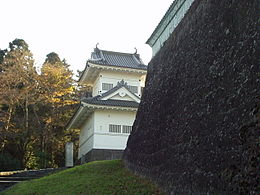
Kubota Castle (Akita)
Kubota Castle reconstruction main enclosure front gate Kubota Castle reconstruction main enclosure front gate
A popular name Yadomi Castle, the kudzu headquarters, Akita Castle
Castle structure A castle on a hill
Castle tower structure Unavailable
The lord of a castle old Yoshinobu Satake
The construction of a castle year 1604(Keicho era nine years)
The main lord of a castle Satake
The abandoned castle year 1880(1880)
Remains of an ancient structure Fieldwork, a moat, the gate, a guard station
Designated cultural assets Akita-shi cultural assets(A leader guard station)
Rebuilding all things in nature This Marushin arms corner oar, a main enclosure front gate
A position 24.53 23.67 lat. 39 degrees N 43 minutes second long. 140 degrees E seven minutes seconds
A summary
It is a castle of Kubota feudal lord Satake. I am called the Yadomi Castle, root of a kudzu Castle. I was able to be called "Akita Castle" concerning land, but the location is together another castle with Akita castle (I got tired come) where Dewa Kokufu was put in the ancient times.
There was a few it, and, in a castle on a hill built in the branch Nibetsu River left bank of the Omono River, the Mt. Akira God in Hodono-mura Kubota (しんめいやま, meters above the sea level 40m), in Ishigaki, it was served fieldwork in the top in a fundus and it could be built and did a palace called a from study with substitute and I built eight oars and was able to line up in the on base without having the castle tower. Ishigaki hesitates not to be it in the Shogunate, and even if I can fold it, it is said when there was not the person who was familiar with the making of Ishigaki, but that the construction of a castle method that originally I do not use Ishigaki for in the eastern country including the former territory Hitachi country of Satake was common is raised. In any case I use Yamakawa Numazawa skillfully and plan defense, and Mizubori and yen Kuo-type castles style of the pilgrimage around the thirty-three holy places in the Kinki district is adopted, too.
The building in the castle was almost destroyed by fire by a big fire of the (1880) in 1880, and most of the moat were filled up by a process of the city rebuilding, too and changed into the government office street. The whole area where there was Kubota Castle becomes Chiaki Park, and Akita citizen of the prefecture hall and Akita municipal institution center library Akinori building, Masakichi Hirano art museum are got ready now. For a building, the leader guard station which escaped from the above-mentioned big fire alone exists, and this Marushin arms corner oar, a main enclosure front gate are rebuilt.
The history / history
Before the Edo era
Miura (Kawajiri) of [4] Ando subordinates was located in the Mt. Akira God and honored a patron saint. The name of the Mt. Akira God comes from this patron saint, too. I was older and was called Mt. Mimori / three Dakeyama because there seemed to be three top.
The Edo era
* It is September 17 (Keicho era seven years) for 1602 years - It is entry into a fortress [5] in Kubota feudal clan Dewaminato Castle that it was Yoshinobu Satake who is the first feudal lord, a castle of Ando.
* It is May (Keicho era eight years) for 1603 years - I construct a castle and start Shinshiro in the Mt. Akira God (a patron saint of Miura, Kawashiri-mura Shimohama, move [6]). I perform the maintenance of the main important doctrine that castle town and Ieyasu Tokugawa promoted at the same time.
* It is August 28 (Keicho era nine years) for 1603 years - The Kubota Shiromoto-maru completion. I do 破却 of Minato Castle and fix Kubota Castle for Honjo. In addition, the main important doctrine abreast of the other feudal clans is completed within this year.
* 1607(Keicho era 12 years) - The town percent (the first) of the inner town starts. Outermost outworks and medium-grade articles enclosure were founded. The town percent of the outside town is considered it to have been started these days.
* 1619(Genna five years) - The town percent (the second) of the inner town starts. Medium-grade articles enclosure cured percent, and left, and tortoise ノ-cho enclosure was founded.
* 1629(Kanei era six years) - The town percent (the third) of the inner town starts. Samurai-cho of Narayama / Hodono / bill / Kawaguchi is founded.
* 1631(Kanei era eight years) - Through the way which links the horse mouth trouble-cho to Kajicho, it establishes this Oomachi line with a highway (Dewa highway).
* Run to (Masayasu two years) from (Kanei era ten years) in 1645 in 1633 - It is Kubota Castle and changing of a name [7] in Kubota Castle.
* 1635(Kanei era 12 years) - Osamu.old
* 1671(Kanbun 11 years) - It is town percent in Atago bottom new mansion.
* 1673(The Enpo era first year) - It is town percent in Tsukiji / Nagano bottom.
* 1699(Genroku era 12 years) - It is town percent in bill Toshincho / bill Nishijin-cho.
* 1781(The Tenmei era first year) - Osamu.old
Modern times
* 1868(1868) - Boshin War. Because the Kubota feudal clan supported new government troop, I took attack from the Shonai feudal clan (Shonai war), and it was approached to Shiroshita 12km, but the Kubota castle avoided the war damage because I received the surrender of Sendai feudal clan / the Yonezawa feudal clan, and Shonai feudal clan withdrew.
* It is June 17 (1869) for 1869 years - Return of the land and people from the feudal lords to the Emperor. The site of a castle becomes the jurisdiction of the ministry of military affairs (the department of army).
* 1871(1871)
o January 13 - I change Kubota feudal clan to Akita feudal clan and rename Kubota castle town to Akitamachi.
o July 14 - Establishment of prefectures in place of feudal domains. The Akita prefectural office is put in the main enclosure.
* It is March 13 (1872) for 1872 years - The Akita prefectural office moves to 土手長町上丁, and Kubota Castle becomes uninhabited.
* It is January 14 (1873) for 1873 years - I become 存城処分 by national castle maintenance or abolition ノ 処分並兵営地等撰定方.
* It is July 19 (1880) for 1880 years - A building in the castle is almost reduced to ashes by a big fire.
* 1890(1890) - The site of castle is disposed of to Satake by the department of army.
It is the reference present age in "the Chiaki Park # history" about the park got ready by the site of castle
* 1989(1989) - I restore this Marushin arms corner oar (a corner oar).
* 2001(2001) - I restore a main enclosure front gate.
* 2004(2004) - 秋田市建都四百年記念祭 holds it.
* It is April 6 (2006) for 2006 years - It is chosen by 100 Japanese fine castles (the ninth).
* It is June (2007) for 2007 years - 100 Japanese fine castle stamp rally of the national scale starts.
Structure
I levelled the most high place of the Mt. Akira God and assumed it a main enclosure, and a main enclosure palace and the government affairs place which were the house of the feudal lord were put here. A front gate (one ノ gate), a rear gate, the obi gay quarters gate, a small back gate, five places of doorways called the side door mouth were established to the surroundings.
I assumed the land where had low one step of the main enclosure East the outworks of a castle, and a government office of the Shogunate in charge of finance, a border government office, the House of prayer place comfort, a time bell, Kinzo, a stable were put.
There were outermost outworks to surround the north / the east / the south of the outworks of a castle, and a chief vassal mansion was put. I call lower Zhongcheng, the northeast a mountain ノ hand (bill Kamimachi) in upper Zhongcheng, the southern part in the eastern part. Hachimanyama in the west (the northwest of the main enclosure) of the mountain ノ hand was included in outermost outworks, too, but small Yahata Corporation / Inari Corporation / 別当寺金乗院 was put not a chief vassal mansion.
I surrounded a main enclosure / the outworks of a castle with Uchibori and surrounded the outermost outworks in an outside moat. Furthermore, there was a north circle in the north side, and a barn and a granary for unhulled rice were put very much. Arms storehouse was put in 捨曲輪 which I was sandwiched in between the western inside and outside moat and became in the shape of an island.
A school and the mansion of the chief vassal were arranged in a circle, and the mansion of the low-class vassal was posted in the domain called "an inner town" of the circumference the inside. The merchant-cho was called "outside town" (I wait), and I was posted in the west of the castle across Asahikawa. A temple was installed in the west intensively in the watches of the night of the outside town.
11/21/2009
11/11/2009
Sendai castle
The Sendai castle (せんだいじょう) is a castle on a hill in blue Hayama of current Aoba-ku, Sendai-shi, Miyagi (Michinoku country Miyagi-gun). The pen name "Aoba-jo Castle." (→ Sendai reference) that there is another name with "Gojoro". It was appointed (2003) on the historic spot of the country on August 27 in 2003.
A summary
I crossed it in about 270 to an establishment of prefectures in place of feudal domains / abandoned castle law after Masamune Date constructed it in the Keicho era year, and it was a castle of Date charges, and it was the administrative office of the Sendai feudal clan. It is appointed on the historic spot of the country.
I could put a function as the fortress away though I repeated restoration without several degrees while earthquakes suffered damage and passed through Boshin War as depths Uetsu powerful feudal lords alliance leader without never watching the war, and I could write it afterwards in the Taisho era from the Meiji early days, and the most were lost. Ote-mon Gate which was few remains of an ancient structure, side oar, 巽門 were appointed to a national treasure (an old national treasure), but it underwent the war by the air raid of the Pacific Wars and was destroyed by fire. Currently, the member of the gate of 寅 converted into the building of the Governor of Miyagi official house front gate is left.
Because I am located in blue Hayama, with a pen name called Aoba-jo Castle (あおばじょう), I generally tend to be called Aoba-jo Castle. This is unidentified whether mountain and which of the castle got the name of "green leaves" with the place name which was created since Sendai castle is done earlier. Blue Hayama comes from one of 仙台七崎 "green leaves ヶ 崎".
The history / history
Before the Edo era
Blue Hayama has a castle from the Date past, and I call myself a castle for 1000 generations, and I can write it at the middle in the Muromachi era from last years in the Kamakura era, and, 1,000 castles, Shimazu will do a castle as Michinoku Mamoru later at the start, and it is told even if Kokubun of local people of Kokubu Zhuang did a castle in last years in the Muromachi era.
The Edo era
When lord of a castle Morishige Kokubun who was an uncle of Masamune Date ran away in rivalry with Masamune, Sendai Castle became the abandoned castle.
I decided Masamune got the permission of Ieyasu Tokugawa after a fight of Sekigahara, and to move a castle to Sendai. I climbed blue Hayama to (Keicho era December 24, 5) on January 28, 1601 and, including the territory, changed the place name to Sendai. The Sendai castle which he built was Yamashiro consisting of a main enclosure and the western citadels of the castle and there was the castle tower, but did not have the castle tower. It was these points, and I turned my back, but it was being prevalent in the times with a matchless impregnable castle at the same period so as, as a result, the Sendai castle did Vizcaino, and to make you say "the only one which I was superior, and was the strongest again of Japan".
However, I started outworks of a castle building, and (Kanei era 14 years) was able to complete Tadamune Date in the next year in 1637 when the world became the peace of mind because the road of Yamagami and the foot was inconvenient. There is it in the inside of Hirose River as well as a main enclosure, but land is a flat place. The present head of a household of the the Dates lived in here, and the administration was done here, too. As for the time, I was missing, but outermost outworks were made with this almost simultaneously in major Kadowaki, the foot of blue Hayama. After this, the Sendai castle became the castle on a hill.
I lost a part of building and Ishigaki sometimes, and, through the Edo era, the Sendai castle was rebuilt by a fire and an earthquake each time. Because Sendai did not need to become the battlefield by the Boshin War either, the Sendai castle was able to put a duty as the fortress away since the foundation without taking attack once.
Modern times
The Tohoku head of the garrison of Imperial Army made Sendai castle the headquarters and was stationed. A main enclosure was destroyed then, and a stone and a tree were diverted to barracks construction. The northeastern stationary troops were renamed to Sendai stationary troops later. Furthermore, the second division was put when stationary troops system turned into a division system.
* A shrine dedicated to the spirits of the war dead was built in the ruins of the main enclosure (1904) in 1904. It is current 宮城縣護國神社.
* A gate built between the main gate and the main house of the palace-styled architecture in the Fujiwara period in the middle to the main enclosure was demolished (1920) in 1920 by Ote-mon Gate, and it was removed and reconstructed by the front gate of existing governor diplomatic establishments.
* Ote-mon Gate and a side oar (a corner oar) are appointed to an old national treasure (1931) in 1931.
* Masamune image was removed (1943) in 1943 by metal kind collection law. It should have dissolved entirely, but it is discovered that the chest was not dissolved by a head after the war. This bust is exhibited now in Sendai Municipal Museum.
* Occupied outworks of a castle list stage dressing rooms were destroyed by fire by an incendiary dropped by B29 of the United States Armed Forces in the case of Sendai air raid by U.S. forces entirely (1945) in Ote-mon Gate, side oar (a corner oar) (a national treasure), a guard tent in before dawn of 10th in July in 1945 of the last years of Pacific Wars, and the defense of the fatherland Shinto shrine was destroyed by fire. The building to be transmitted through by this from the Edo era became only 巽門 (たつみもん) of outermost outworks (there is the opinion destroyed by fire by the war damage of this day).
The present age
* U.S. Army was stationed after the war in the ruins of the second division, and it was lost building remains of an ancient structure for Edo period that existed that Sendai castle sign had entirely by three 丸巽門 having been done 破却 of. The U.S. forces returned here to the (1957) in 1957.
* The Masamune image removed during war (1954) in 1954 is rebuilt by concrete. This was a statue.
Tokoku University was in the outworks of a castle ruins after it was returned and became the Tokoku University Sendai campus. Among Sendai campuses (Sendai north campus, Sendai south campus), four faculty of liberal arts departments of the southern part, an attached library, a place with the attached botanical garden are the outworks of a castle.
* Miyagi Shrine (a name of the occupation period of 宮城縣護國神社) received national land disposal (1950) in 1950 and owned the main enclosure whole area. In Sendai-shi, a castle did not wish it was stolen the Shinto shrine and I negotiated and managed the part of the land and purchased a part. As of 2003 (2003) the part of the main enclosure of a thing of Sendai-shi but a part and a western citadel of the castle of the main enclosure are still things of the defense of the fatherland Shinto shrine. The person visiting the castle will watch a big torii and the signboard which it was written that I "will let you continue Yasukuni shrine official visit" in the place where there was the filling gate that is a central station. The front shrine of the defense of the fatherland Shinto shrine and Aoba-jo Castle museum, a dining room occupy the center of the main enclosure.
* Sendai Municipal Museum was opened (1961) in the outermost outworks ruins in 1961. The moat of outermost outworks stays as Naganuma, Lake five colors.
* A bronze statue was rebuilt (1962) in 1962, and it was erected as a mounting a horse image. Erected it earlier; concrete; stood, and the image was transferred by Iwade Yamashiro of Iwadeyamamachi (existing Osaki City).
* It was appointed (2003) on the historic spot of the country on August 27 in 2003.
* Aoba-jo Castle main enclosure Hall extended business hours than (2005) until 10:00 p.m. in 2005 and has begun to lay emphasis on night sightseeing around the night view of the Sendai-shi inner city to look at from Sendai Shiromoto-maru.
* It was chosen (2006) on April 6 in 2006 by 100 Japanese fine castles (the eighth), and 100 Japanese fine castle stamp rally of the national scale was started in June (2007) in 2007.
* "Moon automatic performance of the wake" to be able to put before Bansui Doi bronze statue with (2008), Sendai / Miyagi destination campaign in 2008 all day long from three times ten times (from 9:00 to 18:00) I increased it in) to 00 for every one hour. In addition, I came to light up Masamune Date mounting a horse image of Sendai Shiromoto-maru and Ishigaki by whole year from sunset to 11:00 p.m. To this, I did a toll parking lot (in the daytime normal car 400 yen / time) in the main enclosure with free opening by night after 6:00 p.m.
A summary
I crossed it in about 270 to an establishment of prefectures in place of feudal domains / abandoned castle law after Masamune Date constructed it in the Keicho era year, and it was a castle of Date charges, and it was the administrative office of the Sendai feudal clan. It is appointed on the historic spot of the country.
I could put a function as the fortress away though I repeated restoration without several degrees while earthquakes suffered damage and passed through Boshin War as depths Uetsu powerful feudal lords alliance leader without never watching the war, and I could write it afterwards in the Taisho era from the Meiji early days, and the most were lost. Ote-mon Gate which was few remains of an ancient structure, side oar, 巽門 were appointed to a national treasure (an old national treasure), but it underwent the war by the air raid of the Pacific Wars and was destroyed by fire. Currently, the member of the gate of 寅 converted into the building of the Governor of Miyagi official house front gate is left.
Because I am located in blue Hayama, with a pen name called Aoba-jo Castle (あおばじょう), I generally tend to be called Aoba-jo Castle. This is unidentified whether mountain and which of the castle got the name of "green leaves" with the place name which was created since Sendai castle is done earlier. Blue Hayama comes from one of 仙台七崎 "green leaves ヶ 崎".
The history / history
Before the Edo era
Blue Hayama has a castle from the Date past, and I call myself a castle for 1000 generations, and I can write it at the middle in the Muromachi era from last years in the Kamakura era, and, 1,000 castles, Shimazu will do a castle as Michinoku Mamoru later at the start, and it is told even if Kokubun of local people of Kokubu Zhuang did a castle in last years in the Muromachi era.
The Edo era
When lord of a castle Morishige Kokubun who was an uncle of Masamune Date ran away in rivalry with Masamune, Sendai Castle became the abandoned castle.
I decided Masamune got the permission of Ieyasu Tokugawa after a fight of Sekigahara, and to move a castle to Sendai. I climbed blue Hayama to (Keicho era December 24, 5) on January 28, 1601 and, including the territory, changed the place name to Sendai. The Sendai castle which he built was Yamashiro consisting of a main enclosure and the western citadels of the castle and there was the castle tower, but did not have the castle tower. It was these points, and I turned my back, but it was being prevalent in the times with a matchless impregnable castle at the same period so as, as a result, the Sendai castle did Vizcaino, and to make you say "the only one which I was superior, and was the strongest again of Japan".
However, I started outworks of a castle building, and (Kanei era 14 years) was able to complete Tadamune Date in the next year in 1637 when the world became the peace of mind because the road of Yamagami and the foot was inconvenient. There is it in the inside of Hirose River as well as a main enclosure, but land is a flat place. The present head of a household of the the Dates lived in here, and the administration was done here, too. As for the time, I was missing, but outermost outworks were made with this almost simultaneously in major Kadowaki, the foot of blue Hayama. After this, the Sendai castle became the castle on a hill.
I lost a part of building and Ishigaki sometimes, and, through the Edo era, the Sendai castle was rebuilt by a fire and an earthquake each time. Because Sendai did not need to become the battlefield by the Boshin War either, the Sendai castle was able to put a duty as the fortress away since the foundation without taking attack once.
Modern times
The Tohoku head of the garrison of Imperial Army made Sendai castle the headquarters and was stationed. A main enclosure was destroyed then, and a stone and a tree were diverted to barracks construction. The northeastern stationary troops were renamed to Sendai stationary troops later. Furthermore, the second division was put when stationary troops system turned into a division system.
* A shrine dedicated to the spirits of the war dead was built in the ruins of the main enclosure (1904) in 1904. It is current 宮城縣護國神社.
* A gate built between the main gate and the main house of the palace-styled architecture in the Fujiwara period in the middle to the main enclosure was demolished (1920) in 1920 by Ote-mon Gate, and it was removed and reconstructed by the front gate of existing governor diplomatic establishments.
* Ote-mon Gate and a side oar (a corner oar) are appointed to an old national treasure (1931) in 1931.
* Masamune image was removed (1943) in 1943 by metal kind collection law. It should have dissolved entirely, but it is discovered that the chest was not dissolved by a head after the war. This bust is exhibited now in Sendai Municipal Museum.
* Occupied outworks of a castle list stage dressing rooms were destroyed by fire by an incendiary dropped by B29 of the United States Armed Forces in the case of Sendai air raid by U.S. forces entirely (1945) in Ote-mon Gate, side oar (a corner oar) (a national treasure), a guard tent in before dawn of 10th in July in 1945 of the last years of Pacific Wars, and the defense of the fatherland Shinto shrine was destroyed by fire. The building to be transmitted through by this from the Edo era became only 巽門 (たつみもん) of outermost outworks (there is the opinion destroyed by fire by the war damage of this day).
The present age
* U.S. Army was stationed after the war in the ruins of the second division, and it was lost building remains of an ancient structure for Edo period that existed that Sendai castle sign had entirely by three 丸巽門 having been done 破却 of. The U.S. forces returned here to the (1957) in 1957.
* The Masamune image removed during war (1954) in 1954 is rebuilt by concrete. This was a statue.
Tokoku University was in the outworks of a castle ruins after it was returned and became the Tokoku University Sendai campus. Among Sendai campuses (Sendai north campus, Sendai south campus), four faculty of liberal arts departments of the southern part, an attached library, a place with the attached botanical garden are the outworks of a castle.
* Miyagi Shrine (a name of the occupation period of 宮城縣護國神社) received national land disposal (1950) in 1950 and owned the main enclosure whole area. In Sendai-shi, a castle did not wish it was stolen the Shinto shrine and I negotiated and managed the part of the land and purchased a part. As of 2003 (2003) the part of the main enclosure of a thing of Sendai-shi but a part and a western citadel of the castle of the main enclosure are still things of the defense of the fatherland Shinto shrine. The person visiting the castle will watch a big torii and the signboard which it was written that I "will let you continue Yasukuni shrine official visit" in the place where there was the filling gate that is a central station. The front shrine of the defense of the fatherland Shinto shrine and Aoba-jo Castle museum, a dining room occupy the center of the main enclosure.
* Sendai Municipal Museum was opened (1961) in the outermost outworks ruins in 1961. The moat of outermost outworks stays as Naganuma, Lake five colors.
* A bronze statue was rebuilt (1962) in 1962, and it was erected as a mounting a horse image. Erected it earlier; concrete; stood, and the image was transferred by Iwade Yamashiro of Iwadeyamamachi (existing Osaki City).
* It was appointed (2003) on the historic spot of the country on August 27 in 2003.
* Aoba-jo Castle main enclosure Hall extended business hours than (2005) until 10:00 p.m. in 2005 and has begun to lay emphasis on night sightseeing around the night view of the Sendai-shi inner city to look at from Sendai Shiromoto-maru.
* It was chosen (2006) on April 6 in 2006 by 100 Japanese fine castles (the eighth), and 100 Japanese fine castle stamp rally of the national scale was started in June (2007) in 2007.
* "Moon automatic performance of the wake" to be able to put before Bansui Doi bronze statue with (2008), Sendai / Miyagi destination campaign in 2008 all day long from three times ten times (from 9:00 to 18:00) I increased it in) to 00 for every one hour. In addition, I came to light up Masamune Date mounting a horse image of Sendai Shiromoto-maru and Ishigaki by whole year from sunset to 11:00 p.m. To this, I did a toll parking lot (in the daytime normal car 400 yen / time) in the main enclosure with free opening by night after 6:00 p.m.
11/08/2009
Tagajo (Taga castle)
Tagajo (たがじょう, たがのき) is a castle installed in the Michinoku country in Japanese Law Code era. I was located in current Tagajo-shi, Miyagi, and I was employed by Kokufu / the naval station. It is appointed on the special historic spot of the country.
A summary
I installed it on the Shiogama hill which was the southeast part of border with the Ezo and the Matsushima hill where it was it as a foothold of military affairs so that the area near Kyoto government of Nara brought "Ezo" (エミシ) and the eastern country residents whom I called it, and did 異民族視 under control.
Before the Tagajo foundation, it is estimated that Kooriyama remains (Taihaku-ku, Sendai-shi) were Michinoku Kokufu.
It is said that (the Jinki era first year), Azumando Onono constructed a castle as for the foundation for 724 years. Other than Michinoku Kokufu, a naval station is put, and storehouses to store up an administrative office and a temple, food are put, and it is thought that I watched circumference with a box oar in a barrier around a castle.
I will put Tagajo of Michinoku Kokufu and the naval station in Dazaifu, the north by this in the south led by Heijokyo in then (the narrow sense) Japan.
Adjacent to the Tagajo administrative office, I conform to "Michinoku Soja shrine" enshrining Michinoku country 100 companies together. I sentence Matsushima-Wan / Senga ノ Ura (Minato, Shiogama) to Kozu as a mental prop in Michinoku country's best ノ 宮鹽竈神社. I become the place of resident of the capital admiration, and there are a lot of song pillows. A city (called のちに Kokufu, Taga (たがのこう)) by the urban area of a capital system was built in the foot of the hill where there was an administrative office and I had a long it and prospered as the land where river transportation of sand Oshikawa and ground transportation of Okuoodo intersected.
Michinoku general prefecture was put in early days, Tagajo in the days of 建武新政期 and north and south morning. The Oshu general prefecture moved to sacred mountain of Date-gun that was a central military commander, the feudal tenure of Yukitomo Date of the general prefecture after the fall of Tagajo.
The history / history
* I found it (the Jinki era first year) for 724 years. I north from Kooriyama remains (Taihaku-ku, Sendai-shi), and Michinoku Kokufu moves. In addition, the appearance in documents is an article of the (Showa era six years) after "Japan for 839 years of the period".
* It is repaired (Tenbyohoji era six years) for 762 years by Emi Fujiwara having a hunt in the early morning.
* What was rebuilt after having been destroyed by fire in a revolt of 伊治呰麻呂 at one time (Hoki era 11 years) for 780 years is written.
* Tamuramaro Sakanoueno performs the subjugation to the Ezo (Enryaku era 21 years) for 802 years, and the naval station is moved with the movement of the front to Isawa castle (Iwate Oshu city), and it is thought that I moved to a function of the supply division.
* A big earthquake happened (Jogan 11 years) in Michinoku country for 869 years, and many institutions were damaged in Tagajo. It revived after this, but I maintained it at the time in the latter half in the tenth century, and it was not managed, and Tagajo gradually collapsed.
* It functions in a position of nine years and the position of Gosannen as a military foothold before the Middle Ages, and Michinoku Kokufu is destroyed by fire to (the Shotoku first year) in 1097. To north and south morning service charges, Akiie Kitabatake appointed in the new government of Kenbu of the Emperor Godaigo by Michinoku Mamoru, Chikafusa Kitabatake of father conformed to 義良親王 (the Emperor Gomurakami) and proceeded to Tagajo, and the new government of Tohoku area that ruled over Tohoku region and North Kanto in Tagajo, Michinoku general prefecture were born.
In late years tanka feast on the curve of a river bank party remains of an ancient structure are excavated and I include the reexamination of the chronological order and attract attention. It is appointed especially on a historic spot, and an administrative office trace and a castle monument, a restored wall are left now.
It was chosen (2006) on April 6 in 2006 by 100 Japanese fine castles (the seventh), and 100 Japanese fine castle stamp rally of the national scale was started in June (2007) in 2007.
A summary
I installed it on the Shiogama hill which was the southeast part of border with the Ezo and the Matsushima hill where it was it as a foothold of military affairs so that the area near Kyoto government of Nara brought "Ezo" (エミシ) and the eastern country residents whom I called it, and did 異民族視 under control.
Before the Tagajo foundation, it is estimated that Kooriyama remains (Taihaku-ku, Sendai-shi) were Michinoku Kokufu.
It is said that (the Jinki era first year), Azumando Onono constructed a castle as for the foundation for 724 years. Other than Michinoku Kokufu, a naval station is put, and storehouses to store up an administrative office and a temple, food are put, and it is thought that I watched circumference with a box oar in a barrier around a castle.
I will put Tagajo of Michinoku Kokufu and the naval station in Dazaifu, the north by this in the south led by Heijokyo in then (the narrow sense) Japan.
Adjacent to the Tagajo administrative office, I conform to "Michinoku Soja shrine" enshrining Michinoku country 100 companies together. I sentence Matsushima-Wan / Senga ノ Ura (Minato, Shiogama) to Kozu as a mental prop in Michinoku country's best ノ 宮鹽竈神社. I become the place of resident of the capital admiration, and there are a lot of song pillows. A city (called のちに Kokufu, Taga (たがのこう)) by the urban area of a capital system was built in the foot of the hill where there was an administrative office and I had a long it and prospered as the land where river transportation of sand Oshikawa and ground transportation of Okuoodo intersected.
Michinoku general prefecture was put in early days, Tagajo in the days of 建武新政期 and north and south morning. The Oshu general prefecture moved to sacred mountain of Date-gun that was a central military commander, the feudal tenure of Yukitomo Date of the general prefecture after the fall of Tagajo.
The history / history
* I found it (the Jinki era first year) for 724 years. I north from Kooriyama remains (Taihaku-ku, Sendai-shi), and Michinoku Kokufu moves. In addition, the appearance in documents is an article of the (Showa era six years) after "Japan for 839 years of the period".
* It is repaired (Tenbyohoji era six years) for 762 years by Emi Fujiwara having a hunt in the early morning.
* What was rebuilt after having been destroyed by fire in a revolt of 伊治呰麻呂 at one time (Hoki era 11 years) for 780 years is written.
* Tamuramaro Sakanoueno performs the subjugation to the Ezo (Enryaku era 21 years) for 802 years, and the naval station is moved with the movement of the front to Isawa castle (Iwate Oshu city), and it is thought that I moved to a function of the supply division.
* A big earthquake happened (Jogan 11 years) in Michinoku country for 869 years, and many institutions were damaged in Tagajo. It revived after this, but I maintained it at the time in the latter half in the tenth century, and it was not managed, and Tagajo gradually collapsed.
* It functions in a position of nine years and the position of Gosannen as a military foothold before the Middle Ages, and Michinoku Kokufu is destroyed by fire to (the Shotoku first year) in 1097. To north and south morning service charges, Akiie Kitabatake appointed in the new government of Kenbu of the Emperor Godaigo by Michinoku Mamoru, Chikafusa Kitabatake of father conformed to 義良親王 (the Emperor Gomurakami) and proceeded to Tagajo, and the new government of Tohoku area that ruled over Tohoku region and North Kanto in Tagajo, Michinoku general prefecture were born.
In late years tanka feast on the curve of a river bank party remains of an ancient structure are excavated and I include the reexamination of the chronological order and attract attention. It is appointed especially on a historic spot, and an administrative office trace and a castle monument, a restored wall are left now.
It was chosen (2006) on April 6 in 2006 by 100 Japanese fine castles (the seventh), and 100 Japanese fine castle stamp rally of the national scale was started in June (2007) in 2007.
11/05/2009
Morioka castle
A summary
"The Morioka castle" is a castle of Morioka feudal clan Nanbu. It is Kamikawa, Kita and a consecutive Kuo type castle on a hill flowing through the の western part constructed a castle on the granite hill which there was in junction place, the current Morioka-shi center of Nakatsugawa drifting to the Southeast. The outworks of a castle were arranged for the north side of the main enclosure, and it was toed the mark in a dried foss during a main enclosure and the outworks of a castle, and a bridge painted in red appeared now, but corridor Bridge (the bridge where the roof hung over) was built over 存城当時. Furthermore, outermost outworks were arranged for the north side, and waist gay quarters, Awaji circle, Sakaki mountain gay quarters were arranged to surround the main enclosure. A castle tower was built in the main enclosure, but the castle tower was not built by hesitation to the Shogunate, and the third floor oar was constructed by a castle tower, and it was done with a substitute. A 12's profit is finished, and it is renamed to a castle tower more in back, 1842.
Ishigaki crossed with white granite gives off conspicuousness in the castle of Tohoku region with much fieldwork. The building is dismantled in the Meiji beginning, and there is few it, and the gate said to that it was removed and reconstructed by a storehouse removed and reconstructed in a castle and the repayment of kindness temple belonging to the Zen sect (excellent 1-5, Sugawacho) of the city stays to the existing thing. In addition, the conclusive evidence which was a castle gate is not provided about the removing and reconstruction gate. In addition, I am not sure whether it is either gate, but a storehouse is removed and reconstructed again by Kitsu-ya head office depths storehouse (south 3-20, Odori), the Iwate river (old beach wisteria brewing, 10, Natayacho), and, in Kiyomizu-dera Temple, a castle gate exists. In addition, the part of the calculation city magistrate's office which there was in the outworks of a castle is removed and reconstructed by the Deqing warehouse (Senboku 1-13-7).
The current Morioka ruins of a castle are got ready as "Iwate-koen Park (pet name Morioka castle trace" Park); of monument inscribed with a poem and Takuboku Ishikawa of Kenji Miyazawa from here
[不来方のお城の草に寝ころびて空に吸はれし十五の心 ]
There are chopped monuments inscribed with a tanka poem in a park.
The history / history
Before the early modern times
There is an opinion to be non-the next with "reverse Shikata" written down to "the description of Michinoku story" as a special feature of the nephew Yori Tachibana sake of Takenori Kiyohara [1] in the days of peace in the latter period.
The early modern times
The Azuchimomoyama era
* As for Nanbu to employ, it was relieved Nobunao Nanbu 10 of the present head of a household than Hideyoshi Toyotomi who carried out world unification in the Azuchimomoyama era power below (Tensho era 18 years) in feudal tenure of Mangoku in the Michinoku country northern part 1590.
* Defeat Masazane Kunohe (Tensho era 19 years) 1591; from 3 Castle 9 Castle (change it to のち "Fukuoka-jo Castle".) I act as current Ninohe-shi Fukuoka;). I was similar and moved the base.
* It is non-a start reputation by advice that it is over with nine houses than Ujisato Gamo and Nagamasa Asano in the north (the Bunroku first year) by the base とすべく leveling of ground in the ground of the next 1592.
* A profit of sincerity direct は 嫡男 which there was in Kyoto commanded it to do construction of a castle directly (Keicho era three years) 1598 and started construction of a castle as a magistrate of the Construction Bureau in Uchibori Izu of the person of military science.
In other words non-original "慶善館" which established in the ground of the next one Kei Fukushi good Awaji who is a point, a subject of Nanbu than this; is "non-a next castle". There was Fukushi for nine birth and the kinsman relations that Nanbu destroyed, and, in here, it was it with a castle of Nanbu because Nanbu who evaded this non-kept away Fukushi from the next.
The Edo era
* It is sincerity direct が death of illness (Keicho era four years) for 1599 years.
* Because I belonged to the profit direct は east armed forces by a fight of Sekigahara (Keicho era five years) 1600, it was relieved than Ieyasu Tokugawa in feudal tenure.
* It was almost completed to (-1615 years) as a castle of total Ishigaki in the Keicho era year and was crowded and "non-checked "岡 which I swelled, and prospered" and a wish to say from the next" with the profit direct は place name in "Morioka". In addition, the rock shaped like a noble's headgear (treasure Oishi) which was found when I levelled the land of profit direct が outermost outworks is enshrined in outermost outworks sign now, and it is done veneration as company treasure of 櫻山神社 (former Awaji Marudai Myojin).
* I pushed forward the construction of the castle town with construction of a castle and I filled up a damp area of the Nakatsugawa northward and sentenced you to a city area. In addition, it was built a bridge "upper ノ bridge" "Nakanohashi" "lower ノ bridge" (Morioka Mitsuhashi) in Nakatsugawa.
* The knob of a bridge post of the product made in bronze moved from Sannohe was touched in "Nakanohashi" in commemoration of castle town construction to (Keicho era 16 years) to "upper ノ bridge" each (Keicho era 14 years) an old prefecture for 1611 years in 1609. The knob of a bridge post of existing "upper ノ bridge" is appointed by the first of the country appointment important art object (now, important cultural property).
* It is in the days of a thing of 3's feudal lord Shigenao for 1633 years that all castles of the Morioka castle were completed (Kanei era ten years). I was destroyed by fire by an accidental fire (Kanei era 11 years) in a main enclosure 1634, the following day and assumed Fukuoka-jo Castle (9 Castle) a castle at one time. It was restored to (Kanei era 12 years) in 1635 of the next year and came back to the Morioka castle again and made the Meiji Restoration the feudal clan agency of the Morioka feudal clan afterward.
The modern present age
* It is an abandoned castle by establishment of prefectures in place of feudal domains (1871) for 1871 years.
* I was considered to be 当初存城 in the abandoned castle law (1874) in 1874, but deterioration was remarkable, and generally it disposed, and the neighbor, most buildings dismantled it, and it was removed and reconstructed. I become the disposal afterwards in the the old feudal lord Nanbus except a building of the land which became the army site.
* It was lent to Iwate (1906) in 1906 and was opened as "Iwate-koen Park".
* The former site of a castle was transferred to Morioka-shi (1934) from the Nanbus in 1934.
* 1937年(昭和12年)城跡は「濠湟石壁土壘尚ヨク存シ舊規模ノ見ルベキモノアリ」として国の史跡に指定された。
* It was chosen (2006) on April 6 in 2006 by 100 Japanese fine castles (the sixth), and 100 Japanese fine castle stamp rally of the national scale was started in June (2007) in 2007.
"The Morioka castle" is a castle of Morioka feudal clan Nanbu. It is Kamikawa, Kita and a consecutive Kuo type castle on a hill flowing through the の western part constructed a castle on the granite hill which there was in junction place, the current Morioka-shi center of Nakatsugawa drifting to the Southeast. The outworks of a castle were arranged for the north side of the main enclosure, and it was toed the mark in a dried foss during a main enclosure and the outworks of a castle, and a bridge painted in red appeared now, but corridor Bridge (the bridge where the roof hung over) was built over 存城当時. Furthermore, outermost outworks were arranged for the north side, and waist gay quarters, Awaji circle, Sakaki mountain gay quarters were arranged to surround the main enclosure. A castle tower was built in the main enclosure, but the castle tower was not built by hesitation to the Shogunate, and the third floor oar was constructed by a castle tower, and it was done with a substitute. A 12's profit is finished, and it is renamed to a castle tower more in back, 1842.
Ishigaki crossed with white granite gives off conspicuousness in the castle of Tohoku region with much fieldwork. The building is dismantled in the Meiji beginning, and there is few it, and the gate said to that it was removed and reconstructed by a storehouse removed and reconstructed in a castle and the repayment of kindness temple belonging to the Zen sect (excellent 1-5, Sugawacho) of the city stays to the existing thing. In addition, the conclusive evidence which was a castle gate is not provided about the removing and reconstruction gate. In addition, I am not sure whether it is either gate, but a storehouse is removed and reconstructed again by Kitsu-ya head office depths storehouse (south 3-20, Odori), the Iwate river (old beach wisteria brewing, 10, Natayacho), and, in Kiyomizu-dera Temple, a castle gate exists. In addition, the part of the calculation city magistrate's office which there was in the outworks of a castle is removed and reconstructed by the Deqing warehouse (Senboku 1-13-7).
The current Morioka ruins of a castle are got ready as "Iwate-koen Park (pet name Morioka castle trace" Park); of monument inscribed with a poem and Takuboku Ishikawa of Kenji Miyazawa from here
[不来方のお城の草に寝ころびて空に吸はれし十五の心 ]
There are chopped monuments inscribed with a tanka poem in a park.
The history / history
Before the early modern times
There is an opinion to be non-the next with "reverse Shikata" written down to "the description of Michinoku story" as a special feature of the nephew Yori Tachibana sake of Takenori Kiyohara [1] in the days of peace in the latter period.
The early modern times
The Azuchimomoyama era
* As for Nanbu to employ, it was relieved Nobunao Nanbu 10 of the present head of a household than Hideyoshi Toyotomi who carried out world unification in the Azuchimomoyama era power below (Tensho era 18 years) in feudal tenure of Mangoku in the Michinoku country northern part 1590.
* Defeat Masazane Kunohe (Tensho era 19 years) 1591; from 3 Castle 9 Castle (change it to のち "Fukuoka-jo Castle".) I act as current Ninohe-shi Fukuoka;). I was similar and moved the base.
* It is non-a start reputation by advice that it is over with nine houses than Ujisato Gamo and Nagamasa Asano in the north (the Bunroku first year) by the base とすべく leveling of ground in the ground of the next 1592.
* A profit of sincerity direct は 嫡男 which there was in Kyoto commanded it to do construction of a castle directly (Keicho era three years) 1598 and started construction of a castle as a magistrate of the Construction Bureau in Uchibori Izu of the person of military science.
In other words non-original "慶善館" which established in the ground of the next one Kei Fukushi good Awaji who is a point, a subject of Nanbu than this; is "non-a next castle". There was Fukushi for nine birth and the kinsman relations that Nanbu destroyed, and, in here, it was it with a castle of Nanbu because Nanbu who evaded this non-kept away Fukushi from the next.
The Edo era
* It is sincerity direct が death of illness (Keicho era four years) for 1599 years.
* Because I belonged to the profit direct は east armed forces by a fight of Sekigahara (Keicho era five years) 1600, it was relieved than Ieyasu Tokugawa in feudal tenure.
* It was almost completed to (-1615 years) as a castle of total Ishigaki in the Keicho era year and was crowded and "non-checked "岡 which I swelled, and prospered" and a wish to say from the next" with the profit direct は place name in "Morioka". In addition, the rock shaped like a noble's headgear (treasure Oishi) which was found when I levelled the land of profit direct が outermost outworks is enshrined in outermost outworks sign now, and it is done veneration as company treasure of 櫻山神社 (former Awaji Marudai Myojin).
* I pushed forward the construction of the castle town with construction of a castle and I filled up a damp area of the Nakatsugawa northward and sentenced you to a city area. In addition, it was built a bridge "upper ノ bridge" "Nakanohashi" "lower ノ bridge" (Morioka Mitsuhashi) in Nakatsugawa.
* The knob of a bridge post of the product made in bronze moved from Sannohe was touched in "Nakanohashi" in commemoration of castle town construction to (Keicho era 16 years) to "upper ノ bridge" each (Keicho era 14 years) an old prefecture for 1611 years in 1609. The knob of a bridge post of existing "upper ノ bridge" is appointed by the first of the country appointment important art object (now, important cultural property).
* It is in the days of a thing of 3's feudal lord Shigenao for 1633 years that all castles of the Morioka castle were completed (Kanei era ten years). I was destroyed by fire by an accidental fire (Kanei era 11 years) in a main enclosure 1634, the following day and assumed Fukuoka-jo Castle (9 Castle) a castle at one time. It was restored to (Kanei era 12 years) in 1635 of the next year and came back to the Morioka castle again and made the Meiji Restoration the feudal clan agency of the Morioka feudal clan afterward.
The modern present age
* It is an abandoned castle by establishment of prefectures in place of feudal domains (1871) for 1871 years.
* I was considered to be 当初存城 in the abandoned castle law (1874) in 1874, but deterioration was remarkable, and generally it disposed, and the neighbor, most buildings dismantled it, and it was removed and reconstructed. I become the disposal afterwards in the the old feudal lord Nanbus except a building of the land which became the army site.
* It was lent to Iwate (1906) in 1906 and was opened as "Iwate-koen Park".
* The former site of a castle was transferred to Morioka-shi (1934) from the Nanbus in 1934.
* 1937年(昭和12年)城跡は「濠湟石壁土壘尚ヨク存シ舊規模ノ見ルベキモノアリ」として国の史跡に指定された。
* It was chosen (2006) on April 6 in 2006 by 100 Japanese fine castles (the sixth), and 100 Japanese fine castle stamp rally of the national scale was started in June (2007) in 2007.
11/01/2009
ne-jo
There is eight ne-jo in the west end of the city area, and there is it on the river terrace of the Mabechi River southern coast. East good temple / 岡前舘 is five consecutive Kuo whom building (gay quarters) affects of Sawasato building-type castle on a hill a main enclosure / building.
The cornerstone of the building trace, gay quarters, a dried foss, fieldwork are accepted as remains of an ancient structure now. The main house / stable / studio / Kaji studio / Itakura / shed / the east gate is restored in a main enclosure.
The history / history
In the days of the north and south Imperial Court
* Military commander / Akiie Kitabatake who belonged to south Imperial Court (Genko era three years, Shokyo era two years) in 1333 conformed to prince / 義良親王 of the Emperor Godaigo as Michinoku provincial governor and did in a downward direction in the Michinoku country. Moroyuki Nanbu was appointed provincial governor charges then and was accompanied.
* The teacher line set up the castle in eight rice bran part county forests (the Kenbu era first year) in 1334. As for the teacher line, it is said to have named "the headquarters" by a wish called the castle becoming the source of the south early in the morning here. I made meritorious services in war by Taiko temple battles, and the teacher line extended power in the Tsugaru district.
* 1338 (the south Imperial Court): For Engen three years, it is the north Imperial Court: ) Moroyuki Nanbu made an expedition to the Takauji Ashikaga subjugation with Akiie Kitabatake in the Ryakuo first year. The teacher line was killed in action with 顕家 by a fight with Moronao Kono of north Imperial Court in the ground of Izumi country Ishizu (existing Nishi-ku, Sakai-shi, Osaka beach temple Ishizu-cho).
After death of the teacher line, 政長 of the younger brother succeeded you. 政長 caught the surrender advice of re-3 from government of Muromachi, but continued keeping the loyalty to the south Imperial Court without following it. However, the power of Nanbu of the remote Oshu northern part was gradually weakened distantly from Kyoto when south Imperial Court gradually became the numerical inferiority.
* Masamitsu of Nanbu 8 generations moved to the headquarters than the worth of the special feature (Akinori four years) in 1393 and planned revival of Nanbu. These eight systems are called him. The times when a skirmish with the circumference was unstable consistently continued afterwards. And three Nanbu who are a same tribe becomes gradually influential.
The Azuchimomoyama era
* I did it, and, as for three lord of a castle Nobunao Nanbu of the head family, it was relieved 帰参 in the case of a position of Odawara (Tensho era 18 years) in seven southern part counties of the feudal tenure 1590 by the cause of Hideyoshi Toyotomi. In doing so, headquarters Hachinohe he was incorporated in the follower of the head family, too.
The Edo era
* Toshinao Nanbu of the head family built the Morioka castle and opened Morioka feudal clan. Hachinohe belonged to the Morioka feudal clan territory at the same time, too.
* A profit depended on Hachinohe he 22 generations / Naohide directly (Kanei era four years) in 1627, and it was it with 移封 in Tono castle (Toono-shi, Iwate), and, in the headquarters, it was it with an abandoned castle.
Modern times / the present age
* It was appointed (1941) on the historic spot of the country on December 13 in 1941.
* It lasted for 11 years than (1983) in 1983, and excavation and a maintenance business were pushed forward.
* The main enclosure main house is restored (1994) in 1994, and the surroundings are got ready as "an open space of the historic spot headquarters".
* It was chosen (2006) on April 6 in 2006 by 100 Japanese fine castles (the fifth), and 100 Japanese fine castle stamp rally of the national scale was started in June (2007) in 2007.
The cornerstone of the building trace, gay quarters, a dried foss, fieldwork are accepted as remains of an ancient structure now. The main house / stable / studio / Kaji studio / Itakura / shed / the east gate is restored in a main enclosure.
The history / history
In the days of the north and south Imperial Court
* Military commander / Akiie Kitabatake who belonged to south Imperial Court (Genko era three years, Shokyo era two years) in 1333 conformed to prince / 義良親王 of the Emperor Godaigo as Michinoku provincial governor and did in a downward direction in the Michinoku country. Moroyuki Nanbu was appointed provincial governor charges then and was accompanied.
* The teacher line set up the castle in eight rice bran part county forests (the Kenbu era first year) in 1334. As for the teacher line, it is said to have named "the headquarters" by a wish called the castle becoming the source of the south early in the morning here. I made meritorious services in war by Taiko temple battles, and the teacher line extended power in the Tsugaru district.
* 1338 (the south Imperial Court): For Engen three years, it is the north Imperial Court: ) Moroyuki Nanbu made an expedition to the Takauji Ashikaga subjugation with Akiie Kitabatake in the Ryakuo first year. The teacher line was killed in action with 顕家 by a fight with Moronao Kono of north Imperial Court in the ground of Izumi country Ishizu (existing Nishi-ku, Sakai-shi, Osaka beach temple Ishizu-cho).
After death of the teacher line, 政長 of the younger brother succeeded you. 政長 caught the surrender advice of re-3 from government of Muromachi, but continued keeping the loyalty to the south Imperial Court without following it. However, the power of Nanbu of the remote Oshu northern part was gradually weakened distantly from Kyoto when south Imperial Court gradually became the numerical inferiority.
* Masamitsu of Nanbu 8 generations moved to the headquarters than the worth of the special feature (Akinori four years) in 1393 and planned revival of Nanbu. These eight systems are called him. The times when a skirmish with the circumference was unstable consistently continued afterwards. And three Nanbu who are a same tribe becomes gradually influential.
The Azuchimomoyama era
* I did it, and, as for three lord of a castle Nobunao Nanbu of the head family, it was relieved 帰参 in the case of a position of Odawara (Tensho era 18 years) in seven southern part counties of the feudal tenure 1590 by the cause of Hideyoshi Toyotomi. In doing so, headquarters Hachinohe he was incorporated in the follower of the head family, too.
The Edo era
* Toshinao Nanbu of the head family built the Morioka castle and opened Morioka feudal clan. Hachinohe belonged to the Morioka feudal clan territory at the same time, too.
* A profit depended on Hachinohe he 22 generations / Naohide directly (Kanei era four years) in 1627, and it was it with 移封 in Tono castle (Toono-shi, Iwate), and, in the headquarters, it was it with an abandoned castle.
Modern times / the present age
* It was appointed (1941) on the historic spot of the country on December 13 in 1941.
* It lasted for 11 years than (1983) in 1983, and excavation and a maintenance business were pushed forward.
* The main enclosure main house is restored (1994) in 1994, and the surroundings are got ready as "an open space of the historic spot headquarters".
* It was chosen (2006) on April 6 in 2006 by 100 Japanese fine castles (the fifth), and 100 Japanese fine castle stamp rally of the national scale was started in June (2007) in 2007.
10/31/2009
Hirosaki Castle
Hirosaki Castle (ひろさきじょう[Hirosaki-jo]) is the castle which there was in Hirosaki-shi, Aomori. Another name / 鷹岡城, Takaoka Castle. A castle tower or an oar constructed in the Edo era exist, and the site of castle is appointed again on the historic spot of the country. Tsugaru he did a castle in the Edo era, and the feudal clan agency of the Hirosaki feudal clan was put.
A summary
I became the center of the political economy of the Tsugaru district as a castle of 47,000 Hirosaki feudal clan Tsugaru he stones in the Edo era. The castle is located in the Tsugaru plains, and the castle is a bridge Kuo type castle on a hill who consisted of main enclosure, outworks of a castle, outermost outworks, four circles, north Kuo, six Kuo of west Kuo. The foundation original scale extended to East-West 612 meters, north and south 947 meters, total area 385,200 square meters. The whole aspect of the castle almost leaves the original form in the abandoned castle for a moat, Ishigaki, fieldwork, and one castle tower, three oars, five passage under a turret exist now. A castle tower is one of the existence castle towers (a castle having a castle tower constructed before the Edo era) had 12 places for in Japan, and it is appointed to the important cultural property of the country. Ryotaro Shiba "go the highway" - In north のまほろば, I introduce Hirosaki-jo Castle with "the one of Japanese seven people Castle".
The history / history
The Azuchimomoyama era
* The Oura sake sincerity that did a retainer to Nanbu (Tensho era 18 years) in 1590 receives a red-seal letter of the feudal tenure relief of 45,000 stones ahead of Nanbu than Hideyoshi Toyotomi whom there was for Odawara attack. I change the family name with Tsugaru in Oura.
* I build sake sincerity, Horikoshi Castle (Hirosaki-shi Horikoshi) (Bunroku three years) in 1594 and move very much from Pucheng. However, it is chosen a candidate of Shinshiro by the reason of the thing that is unsuitable for military affairs by 鷹岡 (the place of Hirosaki-jo Castle).
* The east armed forces get the sake sincerity by a fight of Sekigahara (Keicho era five years) in 1600, and I receive Kamasu of 2,000 stones than Ieyasu Tokugawa, and the Hirosaki feudal clan of 47,000 stones is formed.
The Edo era
* It is started construction of a castle (Keicho era eight years) in 1603 by sake sincerity, 鷹岡.
* I die (Keicho era nine years) in sake sincerity, Kyoto in 1604, and the construction of a castle stops it.
* I reopen two 代信枚 (sincerity Maki), construction of a castle (Keicho era 14 years) in 1609. I convert Horikoshi Castle, 遺材 of large Pucheng and perform construction of a castle with the immediate pace.
* It is the Hirosaki-jo Castle completion (Keicho era 16 years) in only 1 year 1 month for 1611 years.
* It is destroyed by fire (Kanei era four years) in a castle tower of five levels of the fifth floor 1627 by a thunderbolt. The times without the castle tower continued afterward for nearly 200 years.
* I applied for building 9's feudal lord Yasuchika Tsugaru, three levels of oars (culture seven years) in 1810 in the Shogunate, and three stairs oar (a castle tower) of three levels of seen the third floor was built in the main enclosure now.
Modern times
* 分営 of northeastern stationary troops was put (1871) in 1871.
* I abolish 分営 of northeastern stationary troops (1873) in 1873. An abandoned castle is subjected, and a main enclosure palace or military arts place are demolished after this by the abandoned castle law promulgation.
* I apply for the loan of the site of a castle, and bygone feudal clan main Tsugaru he is admitted (1894) for 1894 years so that the public opens the site of castle as citizen Park.
* It is thrown the public open (1895) as Hirosaki Park in 1895 by a citizen.
* Outermost outworks become the Army weapon branch office arsenal (the eighth のち division weapon part) site (1898) in 1898.
* A cherry tree is planted after this (1903) in 1903 and becomes the noted place of the cherry tree.
* Two oars of the oar of the child of Kuo (1906) north for 1906 years and the southwest oar of west Kuo are destruction by fires.
* The Crown Prince (the Emperor Taisho) names a park "a generous garden" (1908) in 1908.
* The bronze statue of Tamenobu Tsugaru of about 4m in height was erected as a commemorative business of the ancestor of a lord sake sincerity Kozo centennial of 1906 (1909) in 1909 by a main enclosure.
* Eight existence building group (I remove the outermost outworks east gate) is appointed to an old national treasure (equivalent to the important cultural property of the existing law) based on a national treasure save method (1937) in 1937.
* The above-mentioned bronze statue was removed (1944) in 1944 by metal delivery in World War II.
The present age
* The existence building group (I remove the outermost outworks east gate) becomes the important cultural property by a cultural properties protection enactment (1950) in 1950.
* It is appointed (1952) on the historic spot of the country in 1952 (I match the new temple posture including Saisho-in Temple with Chosho-ji Temple posture of the temple of the Zen sect street and appoint it).
* The outermost outworks east gate is appointed to the important cultural property of the country (1953) in 1953, and all of existence buildings (9) becomes the important cultural property of the country.
* I remove and reconstruct it than (1979) in a bottom of the cooperation of the Agency for Cultural Affairs, the present location in 1979, and the outworks of a castle east gate police sergeant guard station which became the park keeper lodgings / the worker crew room (1981) in 1981 is restored.
* A historic spot name is changed to "Tsugaru him Castle trace" (Hirosaki-jo Castle trace) with Horikoshi Castle trace being appointed more (1985) on the historic spot of the country in 1985.
* 1999-2000 year (1999) - A main shrine trace and the torii cornerstone are discovered by excavation of) in 12 by building God (the mane) trace of north Kuo.
* The kind village castle trace was added to the historic spot "Tsugaru him Castle trace" of the country as well as Hirosaki-jo Castle trace, Horikoshi Castle trace (2002) in 2002, too, and, as for the total appointment area, it was it with about 1,054,000 square meters.
* There is a charge for entering a kindergarten to north Kuo (2003) a main enclosure in 2003 (during April, November).
* The bronze statue of Tamenobu Tsugaru was restored (2004) in Hirosaki Cultural Center front yard close to the east gate in April in 2004.
* I built the entire surface of the spring sunshine bridge to depend on Nishibori (2005) in December in 2005, and a substitute was performed after an interval of 73 years.
* It was recognized that Ishigaki wall surface of the neighborhood of castle tower swelled out by a secular variation (2007) in June in 2007 and might collapse.
* It was chosen (2006) on April 6 in 2006 by 100 Japanese fine castles (the fourth), and 100 Japanese fine castle stamp rally of the national scale was started in June, 2007.
* The enforcement of 400 construction of a castle anniversaries is planned to (2011) in 2011.
Remains of an ancient structure
A castle tower(The first generation)
The first castle tower is five folds of buildings built in the main enclosure southwest corner (1609) at the time for Keicho era 14 years by Hirosaki feudal clan 2's feudal lord Nobukazu Tsugaru. Inside the sixth floor and the presumed building were next to Aizu Wakamatsu castle castle tower in unprecedented enormousness for the daimyo of 47,000 few stones in Tohoku area. However, it was burnt down by a thunderbolt to (1627) from completion in Kanei era 4 when I did not reach only 20 and internal gunpowder caught fire and woke up an explosion very much and was destroyed by fire. In this castle tower, main enclosure southwest oar was built to the trace without it being rebuilt. Ishigaki is changed greatly, too, and there is not the former trace.
A castle tower(The third floor oar)
A castle tower(From the main enclosure outside)
The castle tower which is the main enclosure only existence architecture repairs main enclosure Tatsumi oar from (1810) in substitution for five folds of castle towers destroyed by fire to (1627) in Kanei era 4 in culture 7, and it is a building of three folds of finished layered pagoda type the third floor to (1811) in culture 8. The height is the lowest in a triple castle tower existing with about 14.4 meters. It was treated as an oar (the third floor oar) without considering it to be the castle tower from considering it to the Shogunate in former times, but I have a role as "the virtual castle tower", and it is treated with most such as books now as a castle tower. Because Matsumae Castle castle tower was destroyed by fire to (1949) in 1949, it is a virtual existence castle tower located in the north most now. It was an independent expression, but it was the compound expression that let the Tamon storage wall oar attach to the north side in former times now. This becoming known to the public oar is done 破却 of (1896) by in 1896.
I take a long direct copy in a window and top and bottom of the interval, and the outer wall covers a copper tile with a white plaster coat basket without, in addition, using the tile of the product made in clay on a roof tile for cold districts. An east side and the southern aspect facing the outside establish the big gabled roof bay window to the first level and the second level and use interval window for a window, and it is gorgeous and is big, and Visual Effects to show continues being put for a small building, and it is it with the practical constitution that is not seen in the other castle towers which displayed lattice windows in the lack of variety without touching at all a bargeboard to facing to the west and a room to the north which are the inside. Wood / the technology of the highest grade is used for the inside by the normal castle tower architecture, but a common oar and equal wood are used in the case of Hirosaki-jo Castle and are plain structurally, and that I spread a tatami mat is not assumed without all the floors establishing the threshold, and it is it with the practical constitution that anticipated that it is used from the first as a warehouse.
Oar / gate others
The existence oar of the outworks of a castle is 3 of three levels of Tatsumi oar / northeast oar / southwest oars. In the gate, 5 of the Kuo carapace of a turtle gate of outermost outworks pursuer the gate / outermost outworks east the gate / outworks of a castle south the gate / outworks of a castle east the gate / the north exist with a figure at the time of the each construction of a castle, and the above is appointed by the important cultural property of the country. In addition, outworks of a castle east gate police sergeant guard station removes and reconstructs it, and it is restored to the original state.
Five castle gates were left according to the said article now, but ten castle gates had construction of a castle at first. Some gates of these are removed and reconstructed for shortening of the term of works from neighboring castles. The north Kuo north gate (the popular name carapace of a turtle gate) and the gate (the popular name Kata gate) in the outermost outworks north hit it for a concrete example, and and it is removed and reconstructed each Taiko temple castle very much from Pucheng.
By the way, "Edo-jo Castle Ote-mon Gate" is made in the warp station Edo era (Ibaraki つくばみらい City) taken advantage of in the location of the historical drama in reference to the gate of Hirosaki-jo Castle.
The temple of the Zen sect-cho to be located in southwest of the outer fence takes the role of the stronghold as Chosho-ji Temple posture (I produce a butterfly and get vug), and a moat, fieldwork, a square are left.
Cultural assets
Important cultural property
* Hirosaki-jo Castle
Two pieces of 天守附棟札
One piece of two 丸辰巳櫓附棟札
One piece of two 丸未申櫓附棟札
Outworks of a castle northeast oar
The outworks of a castle south gate
The outworks of a castle east gate
The outermost outworks pursuer gate
The north Kuo north gate(The carapace of a turtle gate)
* The Hirosaki-jo Castle outermost outworks east gate
A historic spot
* Tsugaru him Castle trace
Hirosaki-jo Castle trace
Important traditional buildings save district
* Samurai residence group of Nakacho
A summary
I became the center of the political economy of the Tsugaru district as a castle of 47,000 Hirosaki feudal clan Tsugaru he stones in the Edo era. The castle is located in the Tsugaru plains, and the castle is a bridge Kuo type castle on a hill who consisted of main enclosure, outworks of a castle, outermost outworks, four circles, north Kuo, six Kuo of west Kuo. The foundation original scale extended to East-West 612 meters, north and south 947 meters, total area 385,200 square meters. The whole aspect of the castle almost leaves the original form in the abandoned castle for a moat, Ishigaki, fieldwork, and one castle tower, three oars, five passage under a turret exist now. A castle tower is one of the existence castle towers (a castle having a castle tower constructed before the Edo era) had 12 places for in Japan, and it is appointed to the important cultural property of the country. Ryotaro Shiba "go the highway" - In north のまほろば, I introduce Hirosaki-jo Castle with "the one of Japanese seven people Castle".
The history / history
The Azuchimomoyama era
* The Oura sake sincerity that did a retainer to Nanbu (Tensho era 18 years) in 1590 receives a red-seal letter of the feudal tenure relief of 45,000 stones ahead of Nanbu than Hideyoshi Toyotomi whom there was for Odawara attack. I change the family name with Tsugaru in Oura.
* I build sake sincerity, Horikoshi Castle (Hirosaki-shi Horikoshi) (Bunroku three years) in 1594 and move very much from Pucheng. However, it is chosen a candidate of Shinshiro by the reason of the thing that is unsuitable for military affairs by 鷹岡 (the place of Hirosaki-jo Castle).
* The east armed forces get the sake sincerity by a fight of Sekigahara (Keicho era five years) in 1600, and I receive Kamasu of 2,000 stones than Ieyasu Tokugawa, and the Hirosaki feudal clan of 47,000 stones is formed.
The Edo era
* It is started construction of a castle (Keicho era eight years) in 1603 by sake sincerity, 鷹岡.
* I die (Keicho era nine years) in sake sincerity, Kyoto in 1604, and the construction of a castle stops it.
* I reopen two 代信枚 (sincerity Maki), construction of a castle (Keicho era 14 years) in 1609. I convert Horikoshi Castle, 遺材 of large Pucheng and perform construction of a castle with the immediate pace.
* It is the Hirosaki-jo Castle completion (Keicho era 16 years) in only 1 year 1 month for 1611 years.
* It is destroyed by fire (Kanei era four years) in a castle tower of five levels of the fifth floor 1627 by a thunderbolt. The times without the castle tower continued afterward for nearly 200 years.
* I applied for building 9's feudal lord Yasuchika Tsugaru, three levels of oars (culture seven years) in 1810 in the Shogunate, and three stairs oar (a castle tower) of three levels of seen the third floor was built in the main enclosure now.
Modern times
* 分営 of northeastern stationary troops was put (1871) in 1871.
* I abolish 分営 of northeastern stationary troops (1873) in 1873. An abandoned castle is subjected, and a main enclosure palace or military arts place are demolished after this by the abandoned castle law promulgation.
* I apply for the loan of the site of a castle, and bygone feudal clan main Tsugaru he is admitted (1894) for 1894 years so that the public opens the site of castle as citizen Park.
* It is thrown the public open (1895) as Hirosaki Park in 1895 by a citizen.
* Outermost outworks become the Army weapon branch office arsenal (the eighth のち division weapon part) site (1898) in 1898.
* A cherry tree is planted after this (1903) in 1903 and becomes the noted place of the cherry tree.
* Two oars of the oar of the child of Kuo (1906) north for 1906 years and the southwest oar of west Kuo are destruction by fires.
* The Crown Prince (the Emperor Taisho) names a park "a generous garden" (1908) in 1908.
* The bronze statue of Tamenobu Tsugaru of about 4m in height was erected as a commemorative business of the ancestor of a lord sake sincerity Kozo centennial of 1906 (1909) in 1909 by a main enclosure.
* Eight existence building group (I remove the outermost outworks east gate) is appointed to an old national treasure (equivalent to the important cultural property of the existing law) based on a national treasure save method (1937) in 1937.
* The above-mentioned bronze statue was removed (1944) in 1944 by metal delivery in World War II.
The present age
* The existence building group (I remove the outermost outworks east gate) becomes the important cultural property by a cultural properties protection enactment (1950) in 1950.
* It is appointed (1952) on the historic spot of the country in 1952 (I match the new temple posture including Saisho-in Temple with Chosho-ji Temple posture of the temple of the Zen sect street and appoint it).
* The outermost outworks east gate is appointed to the important cultural property of the country (1953) in 1953, and all of existence buildings (9) becomes the important cultural property of the country.
* I remove and reconstruct it than (1979) in a bottom of the cooperation of the Agency for Cultural Affairs, the present location in 1979, and the outworks of a castle east gate police sergeant guard station which became the park keeper lodgings / the worker crew room (1981) in 1981 is restored.
* A historic spot name is changed to "Tsugaru him Castle trace" (Hirosaki-jo Castle trace) with Horikoshi Castle trace being appointed more (1985) on the historic spot of the country in 1985.
* 1999-2000 year (1999) - A main shrine trace and the torii cornerstone are discovered by excavation of) in 12 by building God (the mane) trace of north Kuo.
* The kind village castle trace was added to the historic spot "Tsugaru him Castle trace" of the country as well as Hirosaki-jo Castle trace, Horikoshi Castle trace (2002) in 2002, too, and, as for the total appointment area, it was it with about 1,054,000 square meters.
* There is a charge for entering a kindergarten to north Kuo (2003) a main enclosure in 2003 (during April, November).
* The bronze statue of Tamenobu Tsugaru was restored (2004) in Hirosaki Cultural Center front yard close to the east gate in April in 2004.
* I built the entire surface of the spring sunshine bridge to depend on Nishibori (2005) in December in 2005, and a substitute was performed after an interval of 73 years.
* It was recognized that Ishigaki wall surface of the neighborhood of castle tower swelled out by a secular variation (2007) in June in 2007 and might collapse.
* It was chosen (2006) on April 6 in 2006 by 100 Japanese fine castles (the fourth), and 100 Japanese fine castle stamp rally of the national scale was started in June, 2007.
* The enforcement of 400 construction of a castle anniversaries is planned to (2011) in 2011.
Remains of an ancient structure
A castle tower(The first generation)
The first castle tower is five folds of buildings built in the main enclosure southwest corner (1609) at the time for Keicho era 14 years by Hirosaki feudal clan 2's feudal lord Nobukazu Tsugaru. Inside the sixth floor and the presumed building were next to Aizu Wakamatsu castle castle tower in unprecedented enormousness for the daimyo of 47,000 few stones in Tohoku area. However, it was burnt down by a thunderbolt to (1627) from completion in Kanei era 4 when I did not reach only 20 and internal gunpowder caught fire and woke up an explosion very much and was destroyed by fire. In this castle tower, main enclosure southwest oar was built to the trace without it being rebuilt. Ishigaki is changed greatly, too, and there is not the former trace.
A castle tower(The third floor oar)
A castle tower(From the main enclosure outside)
The castle tower which is the main enclosure only existence architecture repairs main enclosure Tatsumi oar from (1810) in substitution for five folds of castle towers destroyed by fire to (1627) in Kanei era 4 in culture 7, and it is a building of three folds of finished layered pagoda type the third floor to (1811) in culture 8. The height is the lowest in a triple castle tower existing with about 14.4 meters. It was treated as an oar (the third floor oar) without considering it to be the castle tower from considering it to the Shogunate in former times, but I have a role as "the virtual castle tower", and it is treated with most such as books now as a castle tower. Because Matsumae Castle castle tower was destroyed by fire to (1949) in 1949, it is a virtual existence castle tower located in the north most now. It was an independent expression, but it was the compound expression that let the Tamon storage wall oar attach to the north side in former times now. This becoming known to the public oar is done 破却 of (1896) by in 1896.
I take a long direct copy in a window and top and bottom of the interval, and the outer wall covers a copper tile with a white plaster coat basket without, in addition, using the tile of the product made in clay on a roof tile for cold districts. An east side and the southern aspect facing the outside establish the big gabled roof bay window to the first level and the second level and use interval window for a window, and it is gorgeous and is big, and Visual Effects to show continues being put for a small building, and it is it with the practical constitution that is not seen in the other castle towers which displayed lattice windows in the lack of variety without touching at all a bargeboard to facing to the west and a room to the north which are the inside. Wood / the technology of the highest grade is used for the inside by the normal castle tower architecture, but a common oar and equal wood are used in the case of Hirosaki-jo Castle and are plain structurally, and that I spread a tatami mat is not assumed without all the floors establishing the threshold, and it is it with the practical constitution that anticipated that it is used from the first as a warehouse.
Oar / gate others
The existence oar of the outworks of a castle is 3 of three levels of Tatsumi oar / northeast oar / southwest oars. In the gate, 5 of the Kuo carapace of a turtle gate of outermost outworks pursuer the gate / outermost outworks east the gate / outworks of a castle south the gate / outworks of a castle east the gate / the north exist with a figure at the time of the each construction of a castle, and the above is appointed by the important cultural property of the country. In addition, outworks of a castle east gate police sergeant guard station removes and reconstructs it, and it is restored to the original state.
Five castle gates were left according to the said article now, but ten castle gates had construction of a castle at first. Some gates of these are removed and reconstructed for shortening of the term of works from neighboring castles. The north Kuo north gate (the popular name carapace of a turtle gate) and the gate (the popular name Kata gate) in the outermost outworks north hit it for a concrete example, and and it is removed and reconstructed each Taiko temple castle very much from Pucheng.
By the way, "Edo-jo Castle Ote-mon Gate" is made in the warp station Edo era (Ibaraki つくばみらい City) taken advantage of in the location of the historical drama in reference to the gate of Hirosaki-jo Castle.
The temple of the Zen sect-cho to be located in southwest of the outer fence takes the role of the stronghold as Chosho-ji Temple posture (I produce a butterfly and get vug), and a moat, fieldwork, a square are left.
Cultural assets
Important cultural property
* Hirosaki-jo Castle
Two pieces of 天守附棟札
One piece of two 丸辰巳櫓附棟札
One piece of two 丸未申櫓附棟札
Outworks of a castle northeast oar
The outworks of a castle south gate
The outworks of a castle east gate
The outermost outworks pursuer gate
The north Kuo north gate(The carapace of a turtle gate)
* The Hirosaki-jo Castle outermost outworks east gate
A historic spot
* Tsugaru him Castle trace
Hirosaki-jo Castle trace
Important traditional buildings save district
* Samurai residence group of Nakacho
10/30/2009
Matsumae Castle
A summary
It is the old castle of the most latter period in Japan with Ishida Castle. I develop the armed forces (Toshizo Hijikata of the Class former newly-compiled book led you) and the offense and defense of the old Shogunate where the Ezo aims at the independence of the island (Hokkaido) in the most last years of the Boshin War, and even what was made to fall is famous. The whole area in the old castle is appointed on the historic spot of the country, and a main enclosure gate of a palace existing again from construction of a castle time is appointed to the important cultural property of the country. It was chosen to Hokkaido inheritance ("Fukuyama-jo Castle" and Teramachi) in 2001.
The history / history
Fukuyama building
I moved to Fukuyama (the position of Matsumae Castle) from Oodate that the Kakizakis (the Matsumaes) regarded as a castle and I could write it from (Keicho era five years) in Keicho era 11 in 1600 and built the encampment. When Russian fleets would visit a shore later, the Shogunate was aimed for the northern guard to (Kaei era two years) in 1849 and commanded Takahiro Matsumae to do Fukuyama building reconstruction (Matsumae construction of a castle).
Construction of a castle
In the case of a construction of a castle plan, there was the opinion to construct a castle geographically on strong position and the Fushiushi mountain (Mt. Hakodate-yama) of the box building that it could be it not Fukuyama of the present location, but I calmed down by a method to expand Fukuyama building that was a house of then Matsumae partly because dissenting opinion and a budget that a merchant of Shiroshita received a blow of the economy in what a castle moved to, and Matsumae Port was deserted said if it was rare and constructed a castle in a tiered stand for dolls type from outermost outworks for the Tsugaru straits in a main enclosure.
Expansion of old Fukuyama building rebuilds it by the territory of the person of Naganuma style military science / Ichikawa's best study and makes a for the first time triple castle tower at this time and I am completed and reach the (the Ansei first year) in 1854 when I came to be called Matsumae castle from these days. I did the passages from Out of the frying pan and into the fire. of the main enclosures of the castle to a main enclosure with the structure that I was easy to shoot with guns from complexity and the side I possessed a battery for bombardment from a warship from the sea side and and I taught you an iron plate in a castle wall. Because the then tile sucked in water in the severe cold of Hokkaido and expanded and might have been able to break it, the castle tower and the roof of the gate covered the covering a roof with shingles in a copper sheet.
The wall of the castle tower painted the framework that I knit out of bamboo between the pillar with plaster, but I taught you a zelkova board firm inside and usually did it with the preparation so that it was born bombardment of Russia round.
The green tuff which it was easy to process comparatively softly that the stone of Ishigaki was produced at a nearby mountain was used, and it was the castle where it was unusual nationwide covered in green Ishigaki. The device how a stone is spread all over so that there is not it of the gap is done so that back soil of Ishigaki begins to flow in the case of thawing for the north ground. Because I have orthopedic treatment with a chisel carefully, and the stone which I piled up without a gap resembles a design of hexangular figure Luo, it is said the carapace of a turtle heaping up. But I was not able to do it with a large-scale castle because there was not so distance from the plateau of Fukuyama that was the center of the castle to the shore.
The offensive and defensive battle in the Boshin War and the fall of a castle
Matsumae Castle experiences the intense offensive and defensive battle without being concerned with the construction of a castle of the late Tokugawa period. The army which did Takeaki Enomoto of the old Shogunate where the Ezo aimed at the independent government establishment in the island with the chief brought each place of the Oshima peninsula under control and Toshizo Hijikata of the cause newly-compiled book group led approximately 700 on November 5 and attacked Matsumae castle in autumn (1868) for 1868 years. Although I tried for a defensive fight, the armed forces of the Matsumae feudal clan have fallen in only several hours. This is because the posture of the castle was too fragile in spite of being the bombardment from a warship of the old Shogunate force warship from the Gulf of Hakodate going away. If the effect that the passage from Ote-mon Gate wound, and it was easy to be it for a thing of a gun was poised, Ichikawa who was a person of military science of Naganuma style did it, but, as the thing which I did not attack, a passage continued on a straight line, and, in the behind the story, the enemy had the gun interval as low deployment of little defense. I have become the form thrust this by Hijikata. Some bullet holes of this time stay in Ishigaki now.
However, the government of Enomoto surrendered in 1869, the following day, and
Matsumae Castle became the possession of Matsumae again, and, in the castle, it was it with possession of the Meiji government by the enforcement of the establishment of prefectures in place of feudal domains of the (1871) in 1871. Castle towers most buildings except the institution of the main enclosure were demolished to (1875) in 1875.
After the Showa era
Although castle tower, main enclosure gate of a palace, main enclosure gate of a palace east wall were based on a national treasure save method to (1941) in 1941, and it was appointed to a then national treasure (equivalent to "the important cultural property" of the existing law), the fire from the Masakicho government office which there was leaped to the site of castle (1949) on June 5 in 1949, and the castle tower and the main enclosure gate of a palace east wall were destroyed by fire afterwards. The castle tower is missing to (1961) from (1959) in 1961 in 1959, and it is rebuilt in steel reinforced concrete construction as Matsumae Castle museum. The building existing from foundation those days is only main enclosure gate of a palace and the main enclosure State Chamber entrance (Hokkaido tangible cultural property) and former Teramachi gate of a palace (the main gate of a Buddhist temple of the inspiration and expiration temple). As for the main enclosure gate of a palace of the old national treasure, the Cultural Properties Protection Act enforcement back of the (1950) is appointed to important cultural property in 1950. In addition, gay quarters / Ishigaki stays well, too, and the former site of a castle whole area is appointed on the historic spot of the country.
It was chosen (2006) on April 6 in 2006 by 100 Japanese fine castles (the third), and 100 Japanese fine castle stamp rally of the national scale was started in June (2007) in 2007.
It is the old castle of the most latter period in Japan with Ishida Castle. I develop the armed forces (Toshizo Hijikata of the Class former newly-compiled book led you) and the offense and defense of the old Shogunate where the Ezo aims at the independence of the island (Hokkaido) in the most last years of the Boshin War, and even what was made to fall is famous. The whole area in the old castle is appointed on the historic spot of the country, and a main enclosure gate of a palace existing again from construction of a castle time is appointed to the important cultural property of the country. It was chosen to Hokkaido inheritance ("Fukuyama-jo Castle" and Teramachi) in 2001.
The history / history
Fukuyama building
I moved to Fukuyama (the position of Matsumae Castle) from Oodate that the Kakizakis (the Matsumaes) regarded as a castle and I could write it from (Keicho era five years) in Keicho era 11 in 1600 and built the encampment. When Russian fleets would visit a shore later, the Shogunate was aimed for the northern guard to (Kaei era two years) in 1849 and commanded Takahiro Matsumae to do Fukuyama building reconstruction (Matsumae construction of a castle).
Construction of a castle
In the case of a construction of a castle plan, there was the opinion to construct a castle geographically on strong position and the Fushiushi mountain (Mt. Hakodate-yama) of the box building that it could be it not Fukuyama of the present location, but I calmed down by a method to expand Fukuyama building that was a house of then Matsumae partly because dissenting opinion and a budget that a merchant of Shiroshita received a blow of the economy in what a castle moved to, and Matsumae Port was deserted said if it was rare and constructed a castle in a tiered stand for dolls type from outermost outworks for the Tsugaru straits in a main enclosure.
Expansion of old Fukuyama building rebuilds it by the territory of the person of Naganuma style military science / Ichikawa's best study and makes a for the first time triple castle tower at this time and I am completed and reach the (the Ansei first year) in 1854 when I came to be called Matsumae castle from these days. I did the passages from Out of the frying pan and into the fire. of the main enclosures of the castle to a main enclosure with the structure that I was easy to shoot with guns from complexity and the side I possessed a battery for bombardment from a warship from the sea side and and I taught you an iron plate in a castle wall. Because the then tile sucked in water in the severe cold of Hokkaido and expanded and might have been able to break it, the castle tower and the roof of the gate covered the covering a roof with shingles in a copper sheet.
The wall of the castle tower painted the framework that I knit out of bamboo between the pillar with plaster, but I taught you a zelkova board firm inside and usually did it with the preparation so that it was born bombardment of Russia round.
The green tuff which it was easy to process comparatively softly that the stone of Ishigaki was produced at a nearby mountain was used, and it was the castle where it was unusual nationwide covered in green Ishigaki. The device how a stone is spread all over so that there is not it of the gap is done so that back soil of Ishigaki begins to flow in the case of thawing for the north ground. Because I have orthopedic treatment with a chisel carefully, and the stone which I piled up without a gap resembles a design of hexangular figure Luo, it is said the carapace of a turtle heaping up. But I was not able to do it with a large-scale castle because there was not so distance from the plateau of Fukuyama that was the center of the castle to the shore.
The offensive and defensive battle in the Boshin War and the fall of a castle
Matsumae Castle experiences the intense offensive and defensive battle without being concerned with the construction of a castle of the late Tokugawa period. The army which did Takeaki Enomoto of the old Shogunate where the Ezo aimed at the independent government establishment in the island with the chief brought each place of the Oshima peninsula under control and Toshizo Hijikata of the cause newly-compiled book group led approximately 700 on November 5 and attacked Matsumae castle in autumn (1868) for 1868 years. Although I tried for a defensive fight, the armed forces of the Matsumae feudal clan have fallen in only several hours. This is because the posture of the castle was too fragile in spite of being the bombardment from a warship of the old Shogunate force warship from the Gulf of Hakodate going away. If the effect that the passage from Ote-mon Gate wound, and it was easy to be it for a thing of a gun was poised, Ichikawa who was a person of military science of Naganuma style did it, but, as the thing which I did not attack, a passage continued on a straight line, and, in the behind the story, the enemy had the gun interval as low deployment of little defense. I have become the form thrust this by Hijikata. Some bullet holes of this time stay in Ishigaki now.
However, the government of Enomoto surrendered in 1869, the following day, and
Matsumae Castle became the possession of Matsumae again, and, in the castle, it was it with possession of the Meiji government by the enforcement of the establishment of prefectures in place of feudal domains of the (1871) in 1871. Castle towers most buildings except the institution of the main enclosure were demolished to (1875) in 1875.
After the Showa era
Although castle tower, main enclosure gate of a palace, main enclosure gate of a palace east wall were based on a national treasure save method to (1941) in 1941, and it was appointed to a then national treasure (equivalent to "the important cultural property" of the existing law), the fire from the Masakicho government office which there was leaped to the site of castle (1949) on June 5 in 1949, and the castle tower and the main enclosure gate of a palace east wall were destroyed by fire afterwards. The castle tower is missing to (1961) from (1959) in 1961 in 1959, and it is rebuilt in steel reinforced concrete construction as Matsumae Castle museum. The building existing from foundation those days is only main enclosure gate of a palace and the main enclosure State Chamber entrance (Hokkaido tangible cultural property) and former Teramachi gate of a palace (the main gate of a Buddhist temple of the inspiration and expiration temple). As for the main enclosure gate of a palace of the old national treasure, the Cultural Properties Protection Act enforcement back of the (1950) is appointed to important cultural property in 1950. In addition, gay quarters / Ishigaki stays well, too, and the former site of a castle whole area is appointed on the historic spot of the country.
It was chosen (2006) on April 6 in 2006 by 100 Japanese fine castles (the third), and 100 Japanese fine castle stamp rally of the national scale was started in June (2007) in 2007.
10/29/2009
100 Japanese fine castle Mito Castle
It is a consecutive Kuo constructed a castle on the hill which is next to a center of Mito-shi, the north side of Mito Station-type castle on a hill. I regarded Naka River and the Lake which flowed through the northern part Chinami who opened in the southern part as a natural moat. The outworks of a castle were arranged for the west of the main enclosure, and, furthermore, outermost outworks were arranged for the east, and each was partitioned off in a dried foss. In addition, a castle did not have Ishigaki and consisted of fieldwork and a dried foss entirely. Though Tokugawa was the castle of three branch families of the Tokugawa house, I was considerably simple when I compared it with Nagoya-jo Castle of the Owari feudal clan, 31-syllable Japanese poem Yamashiro of the Kii feudal clan, and character as the administrative office seems to have been strong rather than say with a castle probably because there was not importance in the defense.
There was the oar of the Edo era in the outworks of a castle in form to extend over an elementary school / the kindergarten attached to current Ibaraki prefectural the third Mito Senior High School and Ibaraki University Department of Education. Outermost outworks have educational institutions for han children, and it is said that the main enclosure was used mainly as a warehouse. What used around a main enclosure of Edo is said that it is about time when it. The castle tower was not constructed, and there was the third floor oar of triple 5 stories.
The the third floor oar avoided the dismantling of the Meiji era, but I am destroyed by fire by an air raid in the Pacific Wars, and it is not rebuilt afterward. In the site of castle, the neighborhood of outworks of a castle / outermost outworks is got ready, and fieldwork / a dried foss exists. In addition, Hiromichi building who was Mito feudal clan educational institution for han children to outermost outworks (the important cultural property of the country, a special historic spot) exists. In addition, of a thing changed of to copper thatching the roof with shingles in the gate with a gable roof (Ibaraki appointment tangible cultural property) exist, and is removed and reconstructed now by the first Ibaraki prefectural Mito high school in the old main enclosure.
The current site of castle becomes the school district, and, other than the amount of Mito 1, Mito Mitaka, the second Mito municipal institution Mito junior high school, Mito municipal institution outermost outworks elementary school, the small / a kindergarten attached to Ibaraki University are built. The outermost outworks elementary school makes school gate and wall, many of school buildings retro-like.
There was a moat between a main enclosure and the outworks of a castle, the outermost outworks, and a bridge was built, but the moat between the outworks of a castle and the outermost outworks was converted into the moat between a main enclosure and the outworks of a castle as a railroad (JR water county Line) as a road (prefectural road 232 Ichige Mito Line) for the Meiji period.
The third floor oar
The first generation of the the third floor oar of Mito Castle is a triple oar called "the third floor patrol", and it was copper thatching the roof with shingles in those days destroyed by fire to (the Meiwa first year) in 1764, but it is said that it is thatch before and was extremely plain. It was rebuilt to (Meiwa three years) in 1766 and, after destruction by fire, became the castle tower in the substance called the the third floor oar. There was not the oar level, and the the third floor oar of the second generation was built on the cornerstone spread in the ground with a layered pagoda type without the bargeboard except the gabled and hipped roof of most Ageju of three folds of appearance inside the fifth floor. I covered the Hatsue lower part in a wall covered with square tiles and jointed with raised plaster in substitution for Ishigaki and showed it as if a triple oar was built on Ishigaki. I existed until early period of Showa, and it was appointed to an old national treasure, but was destroyed by fire by Mito air raid of the (1945) in 1945.
The history / history
I am old, and the construction of a castle dates back to the Heian era until last years before the Edo era. By 馬場資幹 which is the descendant of Kunika Tairano who was the master of the Hitachi country in the Kenkyu era year (1190) - It is said that it was established in 1198 by). I became the castle of Mr. master (Baba) afterward. On this account I was called Baba Castle till Satake entered a fortress.
The Muromachi era began (Oei era 23 years) in 1416, and, in the revolt of Zenshu Uesugi, 大掾満幹 of the present head of a household took part in Zenshu Uesugi side, but the Toru Edo bunch which was available in the Shogunate side was able to beat it. By this, it was replaced, and Edo became the new lord of a castle, and the rule lasted 7's (about 170 years) afterward. Edo is often opposed to Satake who is a master's residence afterward.
Father and son of 通雅 / 通泰 got the position where was equal with a master's residence (Eisho era seven years) in 1510.
Shigemichi Edo took part in Hojo side in the case of Odawara attack of Hideyoshi Toyotomi (Tensho era 18 years) in 1590, and Yoshishige Satake / Yoshinobu father and son did 参陣 adversely in Hideyoshi force. It was given Satake one 54 Hitachi Mangoku than Hideyoshi by this. Yoshishige / Yoshinobu attacked Baba Castle who held out a siege of Edo and let Shigemichi flight to (Bunroku three years) in 1594.
Yoshinobu fixed Mito Castle for an important foothold from Ota Castle of the castle of then and moved a base to here. When Yoshinobu entered a fortress, I repaired a castle very much immediately and changed the castle name to Mito Castle from Baba Castle of then. Because Yoshinobu did it all the time in a vague manner by the fight of Sekigahara of the (Keicho era five years) in 1600, it was commanded the Dewa country Kubota feudal clan to do a change seal than (Keicho era seven years), Ieyasu Tokugawa in 1602.
I let Nobuyoshi Takeda 15 of Itsuo enter a fortress in Mangoku as the good ground where Ieyasu considered Oshu in the same year, but let Yorinobu Tokugawa 20 of ten men enter a fortress in Mangoku because I sank in the (Keicho era eight years) without a heiress in 1603, the following day.
The Edo era
I gave 頼宣 50 駿府藩 Mangoku (Keicho era 14 years) in 1609, and Yorifusa Tokugawa of 11 men entered a fortress with Sueko in 25 Mangoku from Shimotsuma castle, and it was it to 以降, an abandoned castle with the castle of the the Mito Tokugawas. 頼房 expanded a castle and a castle town and set up the house in the outworks of a castle. I did not set up the castle tower and constructed the third floor oar (the inside, 5 stories) without the decorations such as bargeboards in the outworks of a castle. In addition, there is extremely few it, and an oar / the becoming known to the public used many walls, too, but it is good, and this simplicity expresses the family tradition of the the Mito Tokugawas. Hiromichi building of the educational institution for han children was founded to (Tenpo era 12 years) in 1841 by 斉昭 of the 9's feudal lord (斉昭 opens Kairaku-en Garden which is Japanese one of 3 garden in) in the western part of the castle for (Tenpo era 13 years in 1842 of the next year).
The opinion of a feudal clan of the Mito feudal clan was divided by the late Tokugawa period, and the opposition of the long-nosed goblin party of the reformist and the many pupils party of the conservatives happened. A long-nosed goblin party raised an army (the Motoharu first year) at last in Mt. Tsukuba in 1864, and the revolt of the long-nosed goblin party happened. This opposition continued to the Meiji Restoration, and a battle was performed with Mito Shiroshita to (1868) in 1868, and a long-nosed goblin party attacked the many pupils party which shut itself up in Hiromichi building. Many buildings in the castle were destroyed by fire at this verge.
The modern present age
It is an abandoned castle by establishment of prefectures in place of feudal domains (1871) for 1871 years.
It is destroyed by fire with the third floor oar (1945) on August 2 1945 by Mito air raid.
Hiromichi building is appointed (1952) on the special historic spot of the country in 1952.
A Hiromichi building original agency, a highest good temple, the front gate and a wall are appointed to the important cultural property of the country (1964) in 1964.
Fieldwork and a dried foss are appointed (1967) on a historic spot of Ibaraki in 1967.
A gate with a gable roof becomes the listed building of Ibaraki (1983) in 1983.
It was chosen (2006) on April 6 in 2006 by 100 Japanese fine castles (the 14th), and 100 Japanese fine castle stamp rally of the national scale was started in June (2007) in 2007
There was the oar of the Edo era in the outworks of a castle in form to extend over an elementary school / the kindergarten attached to current Ibaraki prefectural the third Mito Senior High School and Ibaraki University Department of Education. Outermost outworks have educational institutions for han children, and it is said that the main enclosure was used mainly as a warehouse. What used around a main enclosure of Edo is said that it is about time when it. The castle tower was not constructed, and there was the third floor oar of triple 5 stories.
The the third floor oar avoided the dismantling of the Meiji era, but I am destroyed by fire by an air raid in the Pacific Wars, and it is not rebuilt afterward. In the site of castle, the neighborhood of outworks of a castle / outermost outworks is got ready, and fieldwork / a dried foss exists. In addition, Hiromichi building who was Mito feudal clan educational institution for han children to outermost outworks (the important cultural property of the country, a special historic spot) exists. In addition, of a thing changed of to copper thatching the roof with shingles in the gate with a gable roof (Ibaraki appointment tangible cultural property) exist, and is removed and reconstructed now by the first Ibaraki prefectural Mito high school in the old main enclosure.
The current site of castle becomes the school district, and, other than the amount of Mito 1, Mito Mitaka, the second Mito municipal institution Mito junior high school, Mito municipal institution outermost outworks elementary school, the small / a kindergarten attached to Ibaraki University are built. The outermost outworks elementary school makes school gate and wall, many of school buildings retro-like.
There was a moat between a main enclosure and the outworks of a castle, the outermost outworks, and a bridge was built, but the moat between the outworks of a castle and the outermost outworks was converted into the moat between a main enclosure and the outworks of a castle as a railroad (JR water county Line) as a road (prefectural road 232 Ichige Mito Line) for the Meiji period.
The third floor oar
The first generation of the the third floor oar of Mito Castle is a triple oar called "the third floor patrol", and it was copper thatching the roof with shingles in those days destroyed by fire to (the Meiwa first year) in 1764, but it is said that it is thatch before and was extremely plain. It was rebuilt to (Meiwa three years) in 1766 and, after destruction by fire, became the castle tower in the substance called the the third floor oar. There was not the oar level, and the the third floor oar of the second generation was built on the cornerstone spread in the ground with a layered pagoda type without the bargeboard except the gabled and hipped roof of most Ageju of three folds of appearance inside the fifth floor. I covered the Hatsue lower part in a wall covered with square tiles and jointed with raised plaster in substitution for Ishigaki and showed it as if a triple oar was built on Ishigaki. I existed until early period of Showa, and it was appointed to an old national treasure, but was destroyed by fire by Mito air raid of the (1945) in 1945.
The history / history
I am old, and the construction of a castle dates back to the Heian era until last years before the Edo era. By 馬場資幹 which is the descendant of Kunika Tairano who was the master of the Hitachi country in the Kenkyu era year (1190) - It is said that it was established in 1198 by). I became the castle of Mr. master (Baba) afterward. On this account I was called Baba Castle till Satake entered a fortress.
The Muromachi era began (Oei era 23 years) in 1416, and, in the revolt of Zenshu Uesugi, 大掾満幹 of the present head of a household took part in Zenshu Uesugi side, but the Toru Edo bunch which was available in the Shogunate side was able to beat it. By this, it was replaced, and Edo became the new lord of a castle, and the rule lasted 7's (about 170 years) afterward. Edo is often opposed to Satake who is a master's residence afterward.
Father and son of 通雅 / 通泰 got the position where was equal with a master's residence (Eisho era seven years) in 1510.
Shigemichi Edo took part in Hojo side in the case of Odawara attack of Hideyoshi Toyotomi (Tensho era 18 years) in 1590, and Yoshishige Satake / Yoshinobu father and son did 参陣 adversely in Hideyoshi force. It was given Satake one 54 Hitachi Mangoku than Hideyoshi by this. Yoshishige / Yoshinobu attacked Baba Castle who held out a siege of Edo and let Shigemichi flight to (Bunroku three years) in 1594.
Yoshinobu fixed Mito Castle for an important foothold from Ota Castle of the castle of then and moved a base to here. When Yoshinobu entered a fortress, I repaired a castle very much immediately and changed the castle name to Mito Castle from Baba Castle of then. Because Yoshinobu did it all the time in a vague manner by the fight of Sekigahara of the (Keicho era five years) in 1600, it was commanded the Dewa country Kubota feudal clan to do a change seal than (Keicho era seven years), Ieyasu Tokugawa in 1602.
I let Nobuyoshi Takeda 15 of Itsuo enter a fortress in Mangoku as the good ground where Ieyasu considered Oshu in the same year, but let Yorinobu Tokugawa 20 of ten men enter a fortress in Mangoku because I sank in the (Keicho era eight years) without a heiress in 1603, the following day.
The Edo era
I gave 頼宣 50 駿府藩 Mangoku (Keicho era 14 years) in 1609, and Yorifusa Tokugawa of 11 men entered a fortress with Sueko in 25 Mangoku from Shimotsuma castle, and it was it to 以降, an abandoned castle with the castle of the the Mito Tokugawas. 頼房 expanded a castle and a castle town and set up the house in the outworks of a castle. I did not set up the castle tower and constructed the third floor oar (the inside, 5 stories) without the decorations such as bargeboards in the outworks of a castle. In addition, there is extremely few it, and an oar / the becoming known to the public used many walls, too, but it is good, and this simplicity expresses the family tradition of the the Mito Tokugawas. Hiromichi building of the educational institution for han children was founded to (Tenpo era 12 years) in 1841 by 斉昭 of the 9's feudal lord (斉昭 opens Kairaku-en Garden which is Japanese one of 3 garden in) in the western part of the castle for (Tenpo era 13 years in 1842 of the next year).
The opinion of a feudal clan of the Mito feudal clan was divided by the late Tokugawa period, and the opposition of the long-nosed goblin party of the reformist and the many pupils party of the conservatives happened. A long-nosed goblin party raised an army (the Motoharu first year) at last in Mt. Tsukuba in 1864, and the revolt of the long-nosed goblin party happened. This opposition continued to the Meiji Restoration, and a battle was performed with Mito Shiroshita to (1868) in 1868, and a long-nosed goblin party attacked the many pupils party which shut itself up in Hiromichi building. Many buildings in the castle were destroyed by fire at this verge.
The modern present age
It is an abandoned castle by establishment of prefectures in place of feudal domains (1871) for 1871 years.
It is destroyed by fire with the third floor oar (1945) on August 2 1945 by Mito air raid.
Hiromichi building is appointed (1952) on the special historic spot of the country in 1952.
A Hiromichi building original agency, a highest good temple, the front gate and a wall are appointed to the important cultural property of the country (1964) in 1964.
Fieldwork and a dried foss are appointed (1967) on a historic spot of Ibaraki in 1967.
A gate with a gable roof becomes the listed building of Ibaraki (1983) in 1983.
It was chosen (2006) on April 6 in 2006 by 100 Japanese fine castles (the 14th), and 100 Japanese fine castle stamp rally of the national scale was started in June (2007) in 2007
10/28/2009
100 Japanese fine castles Goryokaku Fort
The popular name of the castle where Goryokaku Fort (I possess it write it) was constructed in current Hakodate-shi, Hokkaido in the days of Edo in last years and a star-shaped castle constructed in those days Japan. 龍岡城 (unfinished) of Saku-shi, Nagano is known as Goryokaku Fort, too, but "Goryokaku Fort" generally points at it of Hakodate.
The then official name Kameda government office fieldwork (with Yanagino Castle). It is appointed, and it is chosen to Hokkaido inheritance as "Goryokaku Fort and remains of an ancient structure of the box building War" by the special historic spot of the country.
A summary
With the box building opening of a port by the Japan-U.S. sum pro-treaty conclusion, it was constructed by life of Edo Shogunate commander-in-chief of an expeditionary force against the barbarians / Iesada Tokugawa to solve reinforcement and the move of government office problem of the defense capacity. It is Ayasaburo Takeda of the person of Western style military science to have been in charge of a design. I adopt a bastion in the Europe after a battle with the cannon generalized it-style construction of a castle way and star-shaped arrange 堡. As for the total area, 74,990 tsubos (about 247,466m), the execution, Nakagawa source storehouse undertook Bennosuke Matsukawa, the Ishigaki construction to Kisaburo Inoue, the building of the city magistrate's office by an earthwork.
Construction was planned to confront a foreign menace at first, but a menace faded, and a purpose of the construction became the national prestige.
Structure
There was the lack of expense, and the original plan was reduced. As for the half-moon, only one place was made by a great trick. Two folds of half-moons are built in three folds, and an original European bastion-style construction of a castle style constituted 縦深防御, but considerably compares unfavorably with it in one place of only half-moon. In addition, an administrative office box building city magistrate's office was put at the time of the box building opening of a port. It is a construction of a castle style of the original bastion type that there is not space to put an administrative office, and the tall building is constructed as pure military installation because I do not build it to become the target of the cannon and is against it.
The then Japanese castle held the posts and a dwelling (Goryokaku Fort, government office) and military installation without I was different from the Europe that experienced political change and war and the development of guns, and it being almost performed the separation of the fortress which was a palace and the military installation which were a dwelling. Therefore a review to be West expression construction of a castle only for appearances is common. It is Matsuojo after 龍岡城 and the Meiji Restoration that Western style construction of a castle was used any place other than Goryokaku Fort, and Maehashi Castle uses para-Western style construction of a castle partially besides. In addition, the things that Matsumae Castle or Goto Ishida Castle added a battery to the castle of the pure Japanese style were constructed. I understand it what kind of eyes I encounter if such an old castle becomes the stage of the offensive and defensive battle of the modern cannon war if I watch a photograph after the truce of Aizu Wakamatsu castle / the Shirakawa Komine castle.
Actually, in the case of Hakodate war, a lofty building in the top of the building of the box building city magistrate's office became it for a thing of the appearance of the bombardment from a warship of the warship of the Imperial army so that there was it to a photograph. The old Shogunate force which knew it removed a lofty building part in a hurry, but a shooting angle is known for considerable precision and hits the ground in sequence in a fortress. The function as the fortress was already paralyzed by this point in time.
I build the fieldwork for a defense wall, and it is the characteristic of the bastion-style construction of a castle style to absorb the shock of the cannonball. However, fieldwork frozen during winter faced difficulty to collapse in spring if I became warm without meeting a chilly climate of Hokkaido to build the fieldwork in the case of Goryokaku Fort. Therefore I build Ishigaki expressly and can lack in trouble to pile soil on the top. In addition, there was the method to use a tender brick like Fort Samter of the Civil War even if I did not persist in fieldwork.
For the first problem, the construction of a castle style such bastion-style in the Europe is slightly already what obsolescence did. It is a method to use a rifle as a defense weapon to stack a fort, and it is the time when it was shifting to defense that it fixes a cannon in the protection against bullets trench in the Europe of those days. In fact I easily exceeded it, and, in 普仏戦争 of the same period, the French bastion-type fortress was captured by the Kingdom of Prussia armed forces and was shown what obsolescence did as a fortress form. By the way, Daiba built in Tokyo Bay for the same period is a fortress institution with a cannon.
The history / history
I construct it (Ansei four years) in the days of Edo in 1857 and start.
It is duties start (the Motoharu first year) for 1864 years.
I construct it (Keio two years) in 1866 and am completed.
Modern times
Both units of Keisuke Otori corps and Toshizo Hijikata corps of the adherence to the shogunate group occupy Goryokaku Fort (1868) on October 26 in 1868.
It is the box building Administration establishment (1869) in January for 1869 years.
I am defeated by the new government troop, and it is evacuated (1869) on May 18 in 1869. (The details refer to box building War)The building most of the Goryokaku Fort inside were demolished after (1871) in 1871, and the wood was used for the Bureau of Development official dwelling. It was put in the jurisdiction bottom of the department of army afterwards as a parade ground and the fortress.
It is shown generally (1914) as a park in 1914.
Rakuten establishes "a breast old building" in a piece (1917) using the storage of food in 1917. I exhibited a document about the box building War.
It is appointed (1922) on the historic spot of the country in 1922.
The present age
It was appointed in particular (1952) on a historic spot in 1952.
Municipal Hakodate museum Goryokaku Fort annex was opened (1955) in 1955.
Goryokaku Tower was built (1964) in the vicinity of an entrance in 1964.
It is known now as a noted place of the cherry tree. In addition, box building Goryokaku Fort festival is held every year on soil day of May.
Chuuo, Hakodate-shi library is opened (2005) in the Oshima Subprefectural Office former Government building ruins close to the Goryokaku Park west entrance on November 20 in 2005.
New Goryokaku Tower was opened (2006) on April 1 in 2006. 107m in height.
In Hakodate-shi, a then drawing / old photograph starts the reconstruction construction of the box building city magistrate's office based on documents document (2006) from July 13 in 2006 and aims at the completion of 2010. In addition, the municipal Hakodate museum Goryokaku Fort annex closes at November, 2007 at a limit, and the building is going to be dismantled.
The then official name Kameda government office fieldwork (with Yanagino Castle). It is appointed, and it is chosen to Hokkaido inheritance as "Goryokaku Fort and remains of an ancient structure of the box building War" by the special historic spot of the country.
A summary
With the box building opening of a port by the Japan-U.S. sum pro-treaty conclusion, it was constructed by life of Edo Shogunate commander-in-chief of an expeditionary force against the barbarians / Iesada Tokugawa to solve reinforcement and the move of government office problem of the defense capacity. It is Ayasaburo Takeda of the person of Western style military science to have been in charge of a design. I adopt a bastion in the Europe after a battle with the cannon generalized it-style construction of a castle way and star-shaped arrange 堡. As for the total area, 74,990 tsubos (about 247,466m), the execution, Nakagawa source storehouse undertook Bennosuke Matsukawa, the Ishigaki construction to Kisaburo Inoue, the building of the city magistrate's office by an earthwork.
Construction was planned to confront a foreign menace at first, but a menace faded, and a purpose of the construction became the national prestige.
Structure
There was the lack of expense, and the original plan was reduced. As for the half-moon, only one place was made by a great trick. Two folds of half-moons are built in three folds, and an original European bastion-style construction of a castle style constituted 縦深防御, but considerably compares unfavorably with it in one place of only half-moon. In addition, an administrative office box building city magistrate's office was put at the time of the box building opening of a port. It is a construction of a castle style of the original bastion type that there is not space to put an administrative office, and the tall building is constructed as pure military installation because I do not build it to become the target of the cannon and is against it.
The then Japanese castle held the posts and a dwelling (Goryokaku Fort, government office) and military installation without I was different from the Europe that experienced political change and war and the development of guns, and it being almost performed the separation of the fortress which was a palace and the military installation which were a dwelling. Therefore a review to be West expression construction of a castle only for appearances is common. It is Matsuojo after 龍岡城 and the Meiji Restoration that Western style construction of a castle was used any place other than Goryokaku Fort, and Maehashi Castle uses para-Western style construction of a castle partially besides. In addition, the things that Matsumae Castle or Goto Ishida Castle added a battery to the castle of the pure Japanese style were constructed. I understand it what kind of eyes I encounter if such an old castle becomes the stage of the offensive and defensive battle of the modern cannon war if I watch a photograph after the truce of Aizu Wakamatsu castle / the Shirakawa Komine castle.
Actually, in the case of Hakodate war, a lofty building in the top of the building of the box building city magistrate's office became it for a thing of the appearance of the bombardment from a warship of the warship of the Imperial army so that there was it to a photograph. The old Shogunate force which knew it removed a lofty building part in a hurry, but a shooting angle is known for considerable precision and hits the ground in sequence in a fortress. The function as the fortress was already paralyzed by this point in time.
I build the fieldwork for a defense wall, and it is the characteristic of the bastion-style construction of a castle style to absorb the shock of the cannonball. However, fieldwork frozen during winter faced difficulty to collapse in spring if I became warm without meeting a chilly climate of Hokkaido to build the fieldwork in the case of Goryokaku Fort. Therefore I build Ishigaki expressly and can lack in trouble to pile soil on the top. In addition, there was the method to use a tender brick like Fort Samter of the Civil War even if I did not persist in fieldwork.
For the first problem, the construction of a castle style such bastion-style in the Europe is slightly already what obsolescence did. It is a method to use a rifle as a defense weapon to stack a fort, and it is the time when it was shifting to defense that it fixes a cannon in the protection against bullets trench in the Europe of those days. In fact I easily exceeded it, and, in 普仏戦争 of the same period, the French bastion-type fortress was captured by the Kingdom of Prussia armed forces and was shown what obsolescence did as a fortress form. By the way, Daiba built in Tokyo Bay for the same period is a fortress institution with a cannon.
The history / history
I construct it (Ansei four years) in the days of Edo in 1857 and start.
It is duties start (the Motoharu first year) for 1864 years.
I construct it (Keio two years) in 1866 and am completed.
Modern times
Both units of Keisuke Otori corps and Toshizo Hijikata corps of the adherence to the shogunate group occupy Goryokaku Fort (1868) on October 26 in 1868.
It is the box building Administration establishment (1869) in January for 1869 years.
I am defeated by the new government troop, and it is evacuated (1869) on May 18 in 1869. (The details refer to box building War)The building most of the Goryokaku Fort inside were demolished after (1871) in 1871, and the wood was used for the Bureau of Development official dwelling. It was put in the jurisdiction bottom of the department of army afterwards as a parade ground and the fortress.
It is shown generally (1914) as a park in 1914.
Rakuten establishes "a breast old building" in a piece (1917) using the storage of food in 1917. I exhibited a document about the box building War.
It is appointed (1922) on the historic spot of the country in 1922.
The present age
It was appointed in particular (1952) on a historic spot in 1952.
Municipal Hakodate museum Goryokaku Fort annex was opened (1955) in 1955.
Goryokaku Tower was built (1964) in the vicinity of an entrance in 1964.
It is known now as a noted place of the cherry tree. In addition, box building Goryokaku Fort festival is held every year on soil day of May.
Chuuo, Hakodate-shi library is opened (2005) in the Oshima Subprefectural Office former Government building ruins close to the Goryokaku Park west entrance on November 20 in 2005.
New Goryokaku Tower was opened (2006) on April 1 in 2006. 107m in height.
In Hakodate-shi, a then drawing / old photograph starts the reconstruction construction of the box building city magistrate's office based on documents document (2006) from July 13 in 2006 and aims at the completion of 2010. In addition, the municipal Hakodate museum Goryokaku Fort annex closes at November, 2007 at a limit, and the building is going to be dismantled.
100 Japanese fine castles Nemuro Peninsula チャシ trace group
A summary
About 700 チャシ is confirmed in Hokkaido, but Nemuro Peninsula is one of the places where チャシ in particular is concentrated, and about 30 チャシ is confirmed. Of these, 24 places become the historic spot. These チャシ hits it with a thing built from the 16th century to the 18th century in the Edo era from the age of civil strife of the in fun. The moat of チャシ of here is dug in a pyramid roof, and this is a thing of the last form.
In the moat of each チャシ, remains of an ancient structure can confirm state of preservation well now. However, it is unknown what kind of building was built in チャシ for the present.
チャシ is generally regarded as "a fort", but it seems that it was inflected as watch ground and a sacred place, a place of the negotiations.
It was appointed (1983) on the historic spot of the country on April 26 in 1983.
It was chosen (2006) on April 6 in 2006 by 100 Japanese fine castles (most).
A list of チャシ group
The チャルコロモイチャシ location: Onneto, Nemuro-shi, a form: An aspect cliff type, remains of an ancient structure: Dried foss チャルコロフイナ 1 チャシチャルコロフイナ 2 チャシ
ウェンナイチャシ
The location: Honioi, Nemuro-shi, a form: An aspect cliff type, remains of an ancient structure: It is Tomari 2 チャシポントマリ 3 チャシ a dried foss pop
ニランケウシチャシ(ホニオイ east チャシ)
The location: Honioi, Nemuro-shi, a form: An aspect cliff type, remains of an ancient structure: Dried foss ニランケウシ 1 チャシ (ホニオイ east 3 チャシ) ニランケウシ 2 チャシ (ホニオイ east 2 チャシ) ニランケウシ 3 チャシ(ホニオイ east 1 チャシ)
アッケシエトチャシ(キナトイシチャシ)
The location: Honioi, Nemuro-shi, a form: An aspect cliff type, remains of an ancient structure: Dried foss アッケシエト 1 チャシ (キナトイシ 1 チャシ) アッケシエト 2 チャシ(キナトイシ 2 チャシ)
シエナハウシチャシ(スナバウスチャシ)
The location: Among Nemuro-shi Maki, it is a form: An aspect cliff type, remains of an ancient structure: A dried foss
コタンケシチャシ
The location: Among Nemuro-shi Maki, it is a form: Last ceremony of hill, remains of an ancient structure: Dried foss Ainu village poppy 1 tea stamp tongue poppy 2 チャシ
ノッカマフチャシ
The location: Among Nemuro-shi Maki, it is a form: An aspect cliff type, remains of an ancient structure: Dried foss ノッカマフ 1 チャシノッカマフ 2 チャシ
サツコタンチャシ
The location: Toyosato, Nemuro-shi, a form: Last ceremony of hill, remains of an ancient structure: A dried foss
コンブウシムイチャシ(トーサムポロチャシ)
The location: 根室市温根元, a form: An aspect cliff type, remains of an ancient structure: A dried foss
Toe Siam 2 チャシ
The location: 根室市温根元, a form: An aspect cliff type, remains of an ancient structure: Lake dried foss toe Sam polo 5 チャシトーサムポロ R1 west チャシ
ピリカヲタチャシ
The location: 根室市温根元, a form: Last ceremony of hill, remains of an ancient structure: Lake dried foss ヒリカヲタチャシトーサムポロ 1 チャシトーサムポロ L2 チャシ
ヲンネモトチャシ
The オンネモトチャシ location: 根室市温根元, a form: Last ceremony of hill, remains of an ancient structure: A dried foss
アフラモイチャシ
The location: Nemuro-shi falling rock, a form: Last ceremony of hill, remains of an ancient structure: A dried foss
ポンモイチャシ
The location: Nosappu, Nemuro-shi cape, a form: Last ceremony of hill, remains of an ancient structure: A dried foss
About 700 チャシ is confirmed in Hokkaido, but Nemuro Peninsula is one of the places where チャシ in particular is concentrated, and about 30 チャシ is confirmed. Of these, 24 places become the historic spot. These チャシ hits it with a thing built from the 16th century to the 18th century in the Edo era from the age of civil strife of the in fun. The moat of チャシ of here is dug in a pyramid roof, and this is a thing of the last form.
In the moat of each チャシ, remains of an ancient structure can confirm state of preservation well now. However, it is unknown what kind of building was built in チャシ for the present.
チャシ is generally regarded as "a fort", but it seems that it was inflected as watch ground and a sacred place, a place of the negotiations.
It was appointed (1983) on the historic spot of the country on April 26 in 1983.
It was chosen (2006) on April 6 in 2006 by 100 Japanese fine castles (most).
A list of チャシ group
The チャルコロモイチャシ location: Onneto, Nemuro-shi, a form: An aspect cliff type, remains of an ancient structure: Dried foss チャルコロフイナ 1 チャシチャルコロフイナ 2 チャシ
ウェンナイチャシ
The location: Honioi, Nemuro-shi, a form: An aspect cliff type, remains of an ancient structure: It is Tomari 2 チャシポントマリ 3 チャシ a dried foss pop
ニランケウシチャシ(ホニオイ east チャシ)
The location: Honioi, Nemuro-shi, a form: An aspect cliff type, remains of an ancient structure: Dried foss ニランケウシ 1 チャシ (ホニオイ east 3 チャシ) ニランケウシ 2 チャシ (ホニオイ east 2 チャシ) ニランケウシ 3 チャシ(ホニオイ east 1 チャシ)
アッケシエトチャシ(キナトイシチャシ)
The location: Honioi, Nemuro-shi, a form: An aspect cliff type, remains of an ancient structure: Dried foss アッケシエト 1 チャシ (キナトイシ 1 チャシ) アッケシエト 2 チャシ(キナトイシ 2 チャシ)
シエナハウシチャシ(スナバウスチャシ)
The location: Among Nemuro-shi Maki, it is a form: An aspect cliff type, remains of an ancient structure: A dried foss
コタンケシチャシ
The location: Among Nemuro-shi Maki, it is a form: Last ceremony of hill, remains of an ancient structure: Dried foss Ainu village poppy 1 tea stamp tongue poppy 2 チャシ
ノッカマフチャシ
The location: Among Nemuro-shi Maki, it is a form: An aspect cliff type, remains of an ancient structure: Dried foss ノッカマフ 1 チャシノッカマフ 2 チャシ
サツコタンチャシ
The location: Toyosato, Nemuro-shi, a form: Last ceremony of hill, remains of an ancient structure: A dried foss
コンブウシムイチャシ(トーサムポロチャシ)
The location: 根室市温根元, a form: An aspect cliff type, remains of an ancient structure: A dried foss
Toe Siam 2 チャシ
The location: 根室市温根元, a form: An aspect cliff type, remains of an ancient structure: Lake dried foss toe Sam polo 5 チャシトーサムポロ R1 west チャシ
ピリカヲタチャシ
The location: 根室市温根元, a form: Last ceremony of hill, remains of an ancient structure: Lake dried foss ヒリカヲタチャシトーサムポロ 1 チャシトーサムポロ L2 チャシ
ヲンネモトチャシ
The オンネモトチャシ location: 根室市温根元, a form: Last ceremony of hill, remains of an ancient structure: A dried foss
アフラモイチャシ
The location: Nemuro-shi falling rock, a form: Last ceremony of hill, remains of an ancient structure: A dried foss
ポンモイチャシ
The location: Nosappu, Nemuro-shi cape, a form: Last ceremony of hill, remains of an ancient structure: A dried foss
The structure of the Japanese castle 2
Precipice / moat / fieldwork / Ishigaki
As the basic defense institution which constituted Uchibori of Shinoyama Castle, Ishigaki Castle, a precipice (きりぎし) was used with early Yamashiro, but a moat (I dig it) / fieldwork (どるい) was used many before long, and Ishigaki (いしがき) increased. The moat has the forms such as a dried foss, the form of furrow vertical moat other than Mizubori, and the fieldwork says Doi (どい) and I pile root mass and do a moat with an outer wall. I could establish a fence and the wall in the upper part of the fieldwork and I put an abatis (I pick off a slope) on the slope and blocked the invasion of the enemy, and the defense was exceedingly thorough. Ishigaki was able to be used for the pivot of the castle partly in the Middle Ages, but Ishigaki that I loaded building stones onto the surface of the fieldwork from need to be able to be built in the case of Kuo, and strengthened a heavy oar developed when it was the Azuchimomoyama era. After Azuchi Castle, I was combined with the development of the engineering works technology, and large-scale Ishigaki building was built much in West Japan.
koguti
The doorway of the castle is called Out of the frying pan and into the fire. (こぐち). It is often that it is usually bent, and it is made, and there can be the thing that I establish the fieldwork to be called 蔀 (I do it and am rich) and (I shade it) in the front of a castle gate and Out of the frying pan and into the fire. and cannot advance straight and do it. The behind the story gate (からめてもん) was held in Ote-mon Gate / the pursuer gate (おおてもん), the Out of the frying pan and into the fire. of the bottom in Out of the frying pan and into the fire. of the front (the early modern times castle, usually, south) of the castle. The Out of the frying pan and into the fire. was a doorway of the defenders of a castle, and the defense was strengthened particularly severely to become the invasion mouth of the enemy. I say the thing which I open the space of the quadrangle in the Out of the frying pan and into the fire. in rampart, and set up the gate to two folds with measure form Out of the frying pan and into the fire. (ますがたこぐち). Make small gay quarters surrounded by the opposite bank of the moat in the outside of the Out of the frying pan and into the fire. more in a moat as a foothold for an attack (きょうとうほ); this such as Maidashi (and is a horse).
Tsuchihashi and a tree bridge were built over the moat of an enemy and the Out of the frying pan and into the fire. to meet and I was mobile beforehand they took off a board of the tree Bridge or when destruction was special and did it in order to intercept the inside of a castle and outside the castle, the inside of a castle and outside licensed quarters if necessary and moved. There was 桔橋 / a bascule bridge (はねばし) which caught a bridge by Hikihashi to draw into the within the castle other than Hikihashi (a chopstick) such as an abacus bridge (そろばんばし) or the car bridge (くるまばし) in a movement method, the gatepost of the Out of the frying pan and into the fire.
A wall
I partitioned off gay quarters, and the Hazama wall of Himeji-jo Castle was built on Ishigaki / the fieldwork for the purpose of defense. The walls where included an earthen wall / a boarding fence / coat in the Middle Ages, plaster a wall / a sea cucumber wall was used for fire prevention in the early modern times. A wicket to emit an arrow / a bullet is established to a wall and the oar; this such as the interval (/ interval). Called it by the form of the window with circle interval / lozenge interval / shogi Komagata interval / 鎬狭間 / box interval, and there was the stone interval that was opened to put a cut in the top of Ishigaki under the wall. I was called a crenel / gun interval / cannon interval by the use.
An oar
Oar / Yakura (a tower) says the building which served as the patrol level and a warehouse, defense. The oar was usual and I named a number, a direction and said 巽 (Tatsumi) / Gon (うしとら) / Inui (there is it and sews it) oar, and there was the thing which I watched arrival at by uses again, and was called viewing the moon / a drum oar. Small triple oars were able to be usually used in a double oar, the big castle at castles in the early modern times, but, as for the corner oar in the corner of Kuo, there is the example which an oar having structure equal to a castle tower like triple oar and the fifth floor oar in Kumamoto-jo Castle which there was inside in Osaka-jo Castle main enclosure was given to.
A castle tower
It is placed with the last bastion of the castle, and the castle tower which is the symbol of the castle is said even if a large-sized observation tower oar developed.
As for the origin of the name, there are the opinions which came with the god of treasure of the Buddhism, Brahma the Creator, an opinion called a thing named from the place where I enshrined Sakra Deranam Indra (= Lord of Heaven), the building of the lord of a castle from the place such as "castle tower" "Mamoru". There are the opinions such as a thing doing it with Settsu Itami Castle and thing and Yamato becoming known to the public Yamashiro of Hisahide Matsunaga to work as, the thing which, in addition, do it with the Lord of Heaven of the Azuchi castle of Nobunaga Oda, and the first interview in the documents of the castle tower is not yet elucidated enough, besides, about the origin. A castle tower of various forms / shape was built, but a peak of the construction of a castle is fight front and back of Sekigahara, and it is a characteristic that a thing from around 20 meters in height to around 30 meters was built in West Japan in particular like Himeji-jo Castle castle tower.
As the basic defense institution which constituted Uchibori of Shinoyama Castle, Ishigaki Castle, a precipice (きりぎし) was used with early Yamashiro, but a moat (I dig it) / fieldwork (どるい) was used many before long, and Ishigaki (いしがき) increased. The moat has the forms such as a dried foss, the form of furrow vertical moat other than Mizubori, and the fieldwork says Doi (どい) and I pile root mass and do a moat with an outer wall. I could establish a fence and the wall in the upper part of the fieldwork and I put an abatis (I pick off a slope) on the slope and blocked the invasion of the enemy, and the defense was exceedingly thorough. Ishigaki was able to be used for the pivot of the castle partly in the Middle Ages, but Ishigaki that I loaded building stones onto the surface of the fieldwork from need to be able to be built in the case of Kuo, and strengthened a heavy oar developed when it was the Azuchimomoyama era. After Azuchi Castle, I was combined with the development of the engineering works technology, and large-scale Ishigaki building was built much in West Japan.
koguti
The doorway of the castle is called Out of the frying pan and into the fire. (こぐち). It is often that it is usually bent, and it is made, and there can be the thing that I establish the fieldwork to be called 蔀 (I do it and am rich) and (I shade it) in the front of a castle gate and Out of the frying pan and into the fire. and cannot advance straight and do it. The behind the story gate (からめてもん) was held in Ote-mon Gate / the pursuer gate (おおてもん), the Out of the frying pan and into the fire. of the bottom in Out of the frying pan and into the fire. of the front (the early modern times castle, usually, south) of the castle. The Out of the frying pan and into the fire. was a doorway of the defenders of a castle, and the defense was strengthened particularly severely to become the invasion mouth of the enemy. I say the thing which I open the space of the quadrangle in the Out of the frying pan and into the fire. in rampart, and set up the gate to two folds with measure form Out of the frying pan and into the fire. (ますがたこぐち). Make small gay quarters surrounded by the opposite bank of the moat in the outside of the Out of the frying pan and into the fire. more in a moat as a foothold for an attack (きょうとうほ); this such as Maidashi (and is a horse).
Tsuchihashi and a tree bridge were built over the moat of an enemy and the Out of the frying pan and into the fire. to meet and I was mobile beforehand they took off a board of the tree Bridge or when destruction was special and did it in order to intercept the inside of a castle and outside the castle, the inside of a castle and outside licensed quarters if necessary and moved. There was 桔橋 / a bascule bridge (はねばし) which caught a bridge by Hikihashi to draw into the within the castle other than Hikihashi (a chopstick) such as an abacus bridge (そろばんばし) or the car bridge (くるまばし) in a movement method, the gatepost of the Out of the frying pan and into the fire.
A wall
I partitioned off gay quarters, and the Hazama wall of Himeji-jo Castle was built on Ishigaki / the fieldwork for the purpose of defense. The walls where included an earthen wall / a boarding fence / coat in the Middle Ages, plaster a wall / a sea cucumber wall was used for fire prevention in the early modern times. A wicket to emit an arrow / a bullet is established to a wall and the oar; this such as the interval (/ interval). Called it by the form of the window with circle interval / lozenge interval / shogi Komagata interval / 鎬狭間 / box interval, and there was the stone interval that was opened to put a cut in the top of Ishigaki under the wall. I was called a crenel / gun interval / cannon interval by the use.
An oar
Oar / Yakura (a tower) says the building which served as the patrol level and a warehouse, defense. The oar was usual and I named a number, a direction and said 巽 (Tatsumi) / Gon (うしとら) / Inui (there is it and sews it) oar, and there was the thing which I watched arrival at by uses again, and was called viewing the moon / a drum oar. Small triple oars were able to be usually used in a double oar, the big castle at castles in the early modern times, but, as for the corner oar in the corner of Kuo, there is the example which an oar having structure equal to a castle tower like triple oar and the fifth floor oar in Kumamoto-jo Castle which there was inside in Osaka-jo Castle main enclosure was given to.
A castle tower
It is placed with the last bastion of the castle, and the castle tower which is the symbol of the castle is said even if a large-sized observation tower oar developed.
As for the origin of the name, there are the opinions which came with the god of treasure of the Buddhism, Brahma the Creator, an opinion called a thing named from the place where I enshrined Sakra Deranam Indra (= Lord of Heaven), the building of the lord of a castle from the place such as "castle tower" "Mamoru". There are the opinions such as a thing doing it with Settsu Itami Castle and thing and Yamato becoming known to the public Yamashiro of Hisahide Matsunaga to work as, the thing which, in addition, do it with the Lord of Heaven of the Azuchi castle of Nobunaga Oda, and the first interview in the documents of the castle tower is not yet elucidated enough, besides, about the origin. A castle tower of various forms / shape was built, but a peak of the construction of a castle is fight front and back of Sekigahara, and it is a characteristic that a thing from around 20 meters in height to around 30 meters was built in West Japan in particular like Himeji-jo Castle castle tower.
The structure of the Japanese castle
A classification
For the classification of the castle based on geographical features by the person of military science of the Edo era, there are "Herajiro" (ひらじろ) / "castle on a hill" (ひらやまじろ) / "Yamashiro" (やまじろ) / 3. These distinction is not clear.
Constitution
I passed through basic design on the occasion of the construction of a castle the territory (なわばり) or the diameter beginning and said beginning (I respect you), and there was the center for the placement of gay quarters. It is said that the etymology of "the territory" comes from that I set up a rope by practice and inspected the placement of gay quarters. When the early modern times began, various classifications / analysis was accomplished by people of military science. I put "outline type" (I scratch Rin spread it), mountain and Kaikawa arranging gay quarters in the shape of a main enclosure / the outworks of a castle / outermost outworks and a concentric circle in the rear (staunchness), and there are "consecutive Kuo expressions" (れんかくしき) to link independent gay quarters on "bridge Kuo type" (ていかくしき), the ridge top stopping at the direction, but, for a basic form of the territory, a main enclosure tends actually to take those composition form.
An institution
I called a division surrounded with moat and fieldwork / Ishigaki gay quarters / Kuo (くるわ), and the castle consisted by linking these gay quarters some. It was said the circle (まる) in the Edo era. In the gay quarters that played a key role of the defense, outermost outworks tended it to be established the outworks of a castle which were main enclosure (= Oriental fiddle music ring / main Kuo) else. By the castle, oar gay quarters / boatman gay quarters / castle tower gay quarters / a western citadel of the castle (the retired person place of the daimyo) was able to be established. The high gay quarters of the independence characteristics that is next to Maidashi gay quarters, a certain castle with the thing which Maidashi (and it is a horse) made it on a large scale say with from gay quarters / from Kuo (でぐるわ), a fortress (でまる). There is the thing such as Sanada-maru and Nishide-maru of Kumamoto-jo Castle of the position of Osaka.
Generally the institution which the area of each gay quarters could set up narrowly was limited with Yamashiro, but the area of each gay quarters was wide in Heijo, and palaces setting of the large-scale institution was possible.
An outer fence
When a castle becomes the lasting rule foothold from the military base of the temporariness of the Middle Ages, there was the thing that defense line is already established in one fold of outside for the purpose of castle town and vassal corps defense by a component (a second enclosure) of the function of the conventional castle. This "an outer fence" (there is it, and write it) or "an outer wall" (get so vug, and call そとくるわ )"" 惣構 ().) I set out for only a case called the castle, the second enclosure generally, and, in the outer fence, there was the inarticulate thing to include natural geographical features (a mountain / a river) where you said.
For the classification of the castle based on geographical features by the person of military science of the Edo era, there are "Herajiro" (ひらじろ) / "castle on a hill" (ひらやまじろ) / "Yamashiro" (やまじろ) / 3. These distinction is not clear.
Constitution
I passed through basic design on the occasion of the construction of a castle the territory (なわばり) or the diameter beginning and said beginning (I respect you), and there was the center for the placement of gay quarters. It is said that the etymology of "the territory" comes from that I set up a rope by practice and inspected the placement of gay quarters. When the early modern times began, various classifications / analysis was accomplished by people of military science. I put "outline type" (I scratch Rin spread it), mountain and Kaikawa arranging gay quarters in the shape of a main enclosure / the outworks of a castle / outermost outworks and a concentric circle in the rear (staunchness), and there are "consecutive Kuo expressions" (れんかくしき) to link independent gay quarters on "bridge Kuo type" (ていかくしき), the ridge top stopping at the direction, but, for a basic form of the territory, a main enclosure tends actually to take those composition form.
An institution
I called a division surrounded with moat and fieldwork / Ishigaki gay quarters / Kuo (くるわ), and the castle consisted by linking these gay quarters some. It was said the circle (まる) in the Edo era. In the gay quarters that played a key role of the defense, outermost outworks tended it to be established the outworks of a castle which were main enclosure (= Oriental fiddle music ring / main Kuo) else. By the castle, oar gay quarters / boatman gay quarters / castle tower gay quarters / a western citadel of the castle (the retired person place of the daimyo) was able to be established. The high gay quarters of the independence characteristics that is next to Maidashi gay quarters, a certain castle with the thing which Maidashi (and it is a horse) made it on a large scale say with from gay quarters / from Kuo (でぐるわ), a fortress (でまる). There is the thing such as Sanada-maru and Nishide-maru of Kumamoto-jo Castle of the position of Osaka.
Generally the institution which the area of each gay quarters could set up narrowly was limited with Yamashiro, but the area of each gay quarters was wide in Heijo, and palaces setting of the large-scale institution was possible.
An outer fence
When a castle becomes the lasting rule foothold from the military base of the temporariness of the Middle Ages, there was the thing that defense line is already established in one fold of outside for the purpose of castle town and vassal corps defense by a component (a second enclosure) of the function of the conventional castle. This "an outer fence" (there is it, and write it) or "an outer wall" (get so vug, and call そとくるわ )"" 惣構 ().) I set out for only a case called the castle, the second enclosure generally, and, in the outer fence, there was the inarticulate thing to include natural geographical features (a mountain / a river) where you said.
Revival and the reconstruction
Of the example (Oozu castle castle tower) Showa era of the reconstruction castle tower by the carving wood the revival business of the citadel, the construction of the castle tower in particular were performed more, and a revival castle tower was built in simulation castle tower, Osaka-jo Castle before the war in Sumoto castle or Ueno castle. There was much revival of the castle tower mainly, and the Showa war back was performed after Tomiyama Castle sham castle tower construction of the (1954) mainly on 40's in Showa 30's to be called "castle tower revival boom" or "a castle revival boom" in 1954, but the reconstruction by carving wood based on a document after the carving wood reconstruction of three folds of Shirakawa Komine castle oars of the (1990) in 1990 and revival became a principle when that the rebuilding act at the historic spot was faithful came to be demanded in after 1988 when a hometown wound student business of the Takeshita government was carried out by the policies such as the Agency for Cultural Affairs. In addition, a reconstruction business based on documents of Kakegawa-jo Castle castle tower, citadel group, the Shinoyama Castle large drawing room of Kumamoto-jo Castle is performed, and "a revival boom of the Heisei era" or "the second revival boom" call this time. By this time, there is the example that reproduced an oar and a castle gate, a palace, fieldwork, the reconstruction of Ishigaki, the castle of the Middle Ages / a war-torn country excavated again as well as a castle tower. However, as for the gate and the oar, the entrance of the person is limited to conflict with Building Standard Act or firefighting method by the reconstruction construction in traditional technique, and building in itself introduces modern technique into a castle tower by height and regulation in the disaster prevention partly very because there was the dilemma that it is not possible for, and there is the example that reorganization plan in itself is given up like the triple oar of the Sendai castle.
In addition, in the restored building inside, the public almost tends it to be thrown open as a folk museum and a history museum.
After modern times
The example of the existence castle tower: When the Kochi-jo Castle (the main enclosure palace where this side exists) Meiji era began, besides, in the castle of each place, collapse by the requisition of the material by Imperial Army advanced to the (1873) 破却 by the proclaimed abandoned castle law and destruction by fire with the management abandonment in 1873. A government office was put on the site of castle sequentially, and it was newly often that a park and a Shinto shrine were installed, but Imperial Army was almost stationed on all site of castles in the major cities. The site of castle which became they garrison town was considered to be the target of the United States Armed Forces all over the Pacific Wars (Greater East Asia War), and, by an air raid or an A-bomb, citadels before the Edo era when most existed such as Nagoya-jo Castle, 31-syllable Japanese poem Yamashiro, a castle tower and the oars such as Hiroshima-jo Castle, the gate lost it. Some oars or the gate exist now in castle tower (12 existence castle towers) and Osaka-jo Castle or Nagoya-jo Castle of 12 Castle such as Himeji-jo Castle or Kochi-jo Castle. In addition, there are many things which I avoid a fire and war damage and remain in, and, as for the gate or the oar of the castle, most are appointed to important cultural property if I compare it with a castle tower.
The early modern times
It is thought that Ishigaki, castle tower and front and back and Nobunaga Oda who constructed a castle with becoming known to the public Yamashiro and Nobutaka Yamashiro Hisahide Matsunaga as for the form in particular after Muromachi last years such as oars playing a key role of the image of the current castle occurred in the times of front and back that constructed a castle in Azuchi castle. Osaka-jo Castle or Fushimi Castle were built by Hideyoshi Toyotomi, and Ishigaki, a square and "the castle" for the image of the public such as the castle gate comprising the horse soup stock were completed in a castle tower, and the Japanese castle culture was able to be full of prosperity afterwards. I call the castle of this form a castle of Shokuhojidai line in history. The castle of Shokuhojidai line was not made nationwide, and Nobunaga Oda, the many daimyos of the Hideyoshi Toyotomi subordinate personnel built it like the name mainly. Tohoku and Kanto, Shikoku, nine states of war-torn country daimyos build the castle which they were able to add and the fact of each place. Toyotomi, Tokugawa Administration let the daimyo of each place undertake castle construction of the self as world building positively. By this, the technique of a castle of Shokuhojidai line spreads out and shifts to the compromise type castle that I took in partly. In addition, a lot of examples building the castle of Shokuhojidai that hereditary daimyo posted in the district is pure line are seen.
Because it was the Edo era, and feudal lordship law was announced, I supported the in principle big prestigious family and left complete castle, and, in many castles, it was done 破却(Destruction). Many of castles done 破却(Destruction) of were Yamashiro of the Middle Ages. Each daimyo did 破却(Destruction) of a castle of vassals positively to establish rule order of the early modern times, and a collection of let you live to one's Shiroshita. With the foothold military in the castle give a deep significance, and a foothold of the politics, the authority of the feudal lord and a symbol of the power, a meaning as the local landmark become stronger. Furthermore, I let you live, and I let you live, and, as for the business and industry person, a castle town of the early modern times is formed a collection of a collection of with vassals as an economic foothold of the fief. It depends on this flow now that most of a place called a castle town are formed in the Keicho era year. Many of castles were built in the Keicho era year in the early modern times, too. However, it was often that a castle or a castle tower are destroyed by fire by fires, but many feudal clans gradually fall into a financial difficulty, and there are few examples which there is the clamping by the Shogunate such as the Code of the Samurai, and the rebuilding was permitted;. By the way, an institution called the encampment which there was in the Edo era and Daiba and the battery built in the all parts of Japan as measures to the foreign ship by the late Tokugawa period are kinds of the castle. In addition, other than Goryokaku Fort, I largely shorten a budget for term of works or I am affected by the West expression construction of a castle corresponding to the cannon war, and there are Goryokaku Fort some castles where I am affected by the bastion type fortress, and it was constructed a castle, but the things that it is compressed, and construction was called off by the thing which is not at all the thing which can bear the actual fighting, establishment of prefectures in place of feudal domains are often found.
Until the ancient times
There were many highland colonies that were a made fortress village, and, in Japan of the Yayoi period, there was it in the place where a moat colony or the mountain which surrounded the village with a moat were high, but declined as unification of the politics advanced.
The first interview in the documents of the castle included the invisible thing in documents in Mizuki (Mizuki) that the Emperor Tenji got in 664 in this time, and a lot of castles were made at the Inland Sea coast from North Kyushu. In addition, a barrier around a castle which I could write it in Tohoku region where war with the Ezo (I get it and look and do it) led to in the ninth century from the seventh century, and served as military affairs foothold and the administration footholds such as Tagajo or Dewa fence / the Akita castle was built.
These castles come from the concept of the castle wall city of the Sinicism and it was used as Kokufu, but substitutes it because castle wall building was low by building the fences. Law Code system collapses, and these castles begin to become outdated, and the thing which has begun to be built in the times of the samurai is the castle of the narrow sense as the battle foothold.
The first interview in the documents of the castle included the invisible thing in documents in Mizuki (Mizuki) that the Emperor Tenji got in 664 in this time, and a lot of castles were made at the Inland Sea coast from North Kyushu. In addition, a barrier around a castle which I could write it in Tohoku region where war with the Ezo (I get it and look and do it) led to in the ninth century from the seventh century, and served as military affairs foothold and the administration footholds such as Tagajo or Dewa fence / the Akita castle was built.
These castles come from the concept of the castle wall city of the Sinicism and it was used as Kokufu, but substitutes it because castle wall building was low by building the fences. Law Code system collapses, and these castles begin to become outdated, and the thing which has begun to be built in the times of the samurai is the castle of the narrow sense as the battle foothold.
Etymology of "shiro"
I read a character called "the castle" in 訓 with "shiro" by the present, but there does not seem to have been the classical Japanese language "that I ever did" when I watched the history. I used the character called "the fence" other than "a castle" in an early medieval period from the ancient times and called it "ki" (barrier around a castle )(→ Castle (comes)). For example, I called a certain Oonojo "a shiver" near Dazaifu and seem to have called the Dewa fence of Yamagata "でわのき". As for each character, it will be “ じやう (= contemporary kana orthography later in a castle: I came to read じょう) "and a reading, a fence with "a fence".
The etymology of the reading called "shiro" seems to be such a thing. Because I proved right behind Mt. Nara seeing from the capital (Miyako) of Nara, it was named "Yamashiro" in a meaning called the back of the mountain and I was old and wrote the country (South Kyoto) of Yamashiro with "the cold dry wind blowing down from a mountain" in "Yamashiro", the seventh century. Because there was it with "this country natural stronghold, natural product Castle" when the Emperor Kanmu transferred the capital in Heiankyo, there was recognition that this country was a natural castle. You "should control 斯形勝 によりて, new" (794 years) on November 15 Enryaku era 13 years. You should do a cold dry wind blowing down from a mountain country some other time with a Yamashiro country. An Imperial mandate, edict or decree called "was given. I may have done the title with "unpleasant firewood" without remaining in 改字 because there was it when you "should have controlled new", but, actually, 訓(kun) of "shiro" still produced only a character only about "Yamashiro" and 訓(kun) じたので, character string called "Yamashiro" with "Yamashiro" some other time in "a castle". However, it was read because a reading of "Yamashiro" was equivalent to the land where a mountain made a castle, and the times I made a castle on the mountain, and to protect each fief visited it when "the castle" "did" it in the latter period in the Middle Ages. There is 訓(kun) of "shiro" in "the castle" to "a civilization book daily words dictionary" of the (1474) for civilization six years.
A Japanese castle
In Japan, I am various from the moat colony of the ancient times to the castle of early modern Ishigaki and castle tower. I include Daiba and the battery of the late Tokugawa period in a castle. The camp with gay quarters (くるわ) may say "a castle". As for the building, it is it from a fabrication (さくじ, a building) to make building (ふしん, public works) to build a moat and the fieldwork and the gate and a wall. A mansion and an oar / the castle tower are included in a fabrication, too.
In Japan of the Middle Ages, there was the samurai who was a combatant mainly. In the castles such as daimyos, the family lived inside, and there was the woman who did everyday care. At the big castle, the neighboring towns were able to get a busy outer fence. The castle of the biggest in Japan is Edo-jo Castle. There is the castle in each place a lot till feudal lordship law is promulgated in 1615 of the early modern times, and it is said when there was tens of thousands castle when I can include the small thing such as the fort. In the Middle Ages / the early modern times, the encampment made with building and building built in the level ground assumes encampment and building, the thing which few can approach the castle, and was made of the only castle posture that I do not include in a castle a castle
Subscribe to:
Posts (Atom)